





Written by Constantinos Kyprios
The recent threat by the Turkish Republic against Rhodes appears to be a part of a broader national strategy, most probably driven by the momentum Ankara believes it is gaining from the Mecca Accord. A cornerstone of this strategy is the planned upgrade of the Aksaz Naval Base.The new facilities include the construction of new jetties large enough to accommodate the amphibious assault ship TCG Anadolu and the fleet replenishment ship TCG Deryai. The project also includes the construction of docks, piers, and coastal support facilities, which are expected to accommodate AIP-equipped submarines and other naval assets. The base is also planned to support Unmanned Surface Vehicles (USVs), alongside the creation of the USV Group Command in Didim, Aydin. This command is intended to oversee operations involving USVs and to serve as a hub for logistics, Command and Control, and the deployment and management of USV operations in the region.
These developments are taking place under the Maritime Capability Program Plan, which includes six projects with a total estimated value of approximately €290 million. The projects include the extension of Pier No.1 and the construction of five additional piers, the construction of a breakwater at Agalar, additional mooring facilities at Karadeniz and Eregli, the extension of Pier No. 3 at Gölcük. The expansion of these naval facilities, in conjunction with the other infrastructure been constructed or under development, will facilitate a greater level of Turkish naval operations in the Southeastern Aegean and the Eastern Mediterranean. In this context, vessels such as TCG Anadolu that have been designed primarily for operations in the wider maritime environment of the Eastern Mediterranean rather than that in the confined waters of the central Aegean and the Dodecanese will operate with greater ease. Consequently, the strategic implications of these developments extend beyond Rhodes and Crete and also expands to the waters adjust to Cyprus. In the case of Rhodes, the principal concern relates to the island itself and the surrounding maritime and territorial environment.
Further facilities are also planned. However, the significance of both the drone command infrastructure and the associated port facilities lies primarily in their ability to support a range of unmanned systems capable of operating in the complex maritime environment of the Dodecanese and the surrounding archipelago. To understand the potential danger, it is important to examine the capabilities of these systems. One example is the TCB Marlin, with a displacement of approximately 21 long tons, a maximum speed of 35 knots, a range of approximately 1,900 kilometers, and an endurance of up to 72 hours. Its endurance allows it to remain operational for extended periods. The system can be armed with a 12.7 mm gun, guided missiles, and a lightweight torpedo, while also carrying its own suite of electronic systems.As such it can either perform Anti-Submarine Warfare (ASW) or Electronic Warfare (EW) missions.
In its ASW configuration, it can be equipped with sonar and other associated systems, while in the EW configuration incorporates electronic attack and electronic support capabilities. The platform can also potentially carry solid-propellant rocket-powered missiles, such as the Kuzgun-KY. Such a missile is reported to have a range of approximately 15 to 50 kilometers and can be fitted with different warhead configurations, including high-explosive fragmentation, thermobaric, or explosively formed penetrator (EFP) warheads. Its guidance architecture may incorporate Semi-Active Laser (SAL), Imaging Infrared (IIR), or millimeter-wave (MMW) radar seekers, together with GPS/INS navigation, CRPA anti-jamming capabilities, and Home-on-Jam (HOJ) functionality. These characteristics illustrate the broader spectrum of capabilities that those unmanned platforms can potentially exploite.
The ULAQH is another example. It has a reported operational range of approximately 65–70 kilometers and an overall range exceeding 400 kilometers, while being capable of both autonomous operation and remote control from land-based command centers. Its mission set includes Anti-Surface Warfare (ASuW), ASW, Intelligence, Surveillance and Reconnaissance (ISR), and Electronic Warfare operations.The system can be equipped with Roketsan Cirit and L-UMTAS missile systems. The Cirit has a reported range of approximately 8 kilometers, while the L-UMTAS is designed for longer-range engagements and incorporates a tandem high-explosive warhead. These systems illustrate the breadth of capabilities that can potentially be integrated into unmanned naval platforms. A similar example is the SALVO Sancar UCAV, another unmanned platform capable of carrying a 12.7 mm gun and a 2×2 missile configuration. Like other platforms in this category, it incorporates advanced command-and-control capabilities, and an integrated network.
The Turkish drone fleet also includes kamikaze surface vehicles, such as the YAKTU and Albatross, with ranges of up to approximately 200 nautical miles and speeds of around 50 knots. Such systems can operate in swarm formations, as can many other types of drones. Although individual systems may not be capable of inflicting catastrophic damage on a major surface combatant—as demonstrated by the attack on USS Cole heir use in coordinated swarm operations, supported by modern command-and-control (C2) systems, could potentially overwhelm a major surface unit depending on the number of systems employed. This capability is particularly relevant in the complex island environment of the Aegean Sea, where many naval and maritime-security units are relatively small, ranging from patrol and missile boats to corvettes and frigates. In such an environment, coordinated attacks by multiple unmanned surface vehicles could potentially cause severe damage and result in significant losses.More broadly, these drones can support a variety of missions. Although the missiles carried by some of these systems may be too small to pose a decisive threat to large naval vessels, they can be highly effective in asymmetric warfare against smaller and more vulnerable targets. These may include boats carrying special forces or commandos, attack craft, patrol vessels, and intelligence-gathering or surveillance ships.
Consequently, such systems could play an important role in the Aegean’s complex archipelagic environment, particularly in missions involving maritime patrol, surveillance, intelligence collection, and reconnaissance. Their relatively small size and potential ability to operate in groups could provide additional flexibility in monitoring and engaging vessels operating among the islands.The same systems could also be employed defensively or in support roles for intelligence collection and electronic warfare (EW). In an EW role, multiple drones could operate together to establish a distributed electronic-warfare pfield over a relatively large area. Working in conjunction with other platforms and systems, they could not only collect electronic information but also conduct active and passive electronic-warfare operations, including interference or jamming of communications, interceptions and target acquisition.
Given the large number and variety of these weapon systems, they can be employed to cover a broad geographical area and engage a wide range of targets while performing multiple missions. In an archipelagic environment such as the central and southern Aegean and the Dodecanese, they could be employed in a great effectiveness against the smaller assets operated by the Hellenic Navy, many of which are designed to perform important surveillance, reconnaissance, intelligence-collection, and patrol missions. Possible tragets include vessels such as the Island-class patrol boats and the Pirpolitis-class vessels. Furthermore, such systems could be employed against the asymmetric maritime assets operated by the Greek amphibious forces, including the amphibious commando units and the Z Battalion, that rely on small craft to conduct their missions. Their potential role in Anti-Submarine Warfare (ASW) is also significant. Although individual platforms are relatively small, their large numbers would allow them to conduct ASW operations across a wide area.
Another important capability is the potential establishment of an Electronic Warfare (EW) environment over an extensive area. Large numbers of relatively small and difficult-to-detect unmanned platforms could be deployed across a wide geographical area, creating a distributed electronic-warfare network capable of disrupting or interfering with communications and degrading the effectiveness of electronic systems aboard Greek naval vessels, including radars, targeting systems, and other sensors. Those platforms could also contribute to ASW operations by searching for and tracking submarines across larger areas. The employment of numerous relatively small platforms would make detection more difficult and could therefore provide advantages in persistent surveillance and submarine-hunting operations.
Finally, kamikaze or suicide unmanned surface vehicles represent a potential threat even to major naval units. The attack on USS Cole in Yemen demonstrated the vulnerability of a major warship to a comparatively small suicide craft. A single explosive-laden fast boat was able to cause severe damage and temporarily remove the destroyer from operational service. The potential employment of multiple such systems in coordinated swarm formations would increase the threat considerably and could, under certain circumstances, pose a risk even to major surface combatants. Their relatively simple construction and potentially low acquisition cost further increase their attractiveness as asymmetric weapons. Consequently, the development of a new naval base incorporating advanced command-and-control (C2) installations, together with the deployment of large numbers and diverse types of unmanned surface systems by the Turkish Navy, could provide Turkey with a significant advantage in the asymmetric-warfare spectrum. These systems could simultaneously support a range of missions, including Electronic Warfare, Intelligence, Surveillance and Reconnaissance (ISR), and Anti-Submarine Warfare.
Unmanned systems are becoming an increasingly important component of the arsenal of the Turkish Armed Forces, while their maritime capabilities are complemented by a growing fleet of air-based unmanned platforms. The TAI Anka-3 is among the most important platforms in the Turkish inventory. It incorporates a synthetic-aperture radar and satellite communications capabilities and can carry precision-guided munitions. The platform is also being developed with Electronic Warfare (EW) and Signals Intelligence (SIGINT) capabilities. It has a reported payload capacity of approximately 1,600 kilograms and a maximum speed of around 787 kilometers per hour, with a cruise speed of approximately 460 kilometers per hour. Its reported combat radius is approximately 1,075 kilometers, with an endurance of up to 10 hours. The aircraft has two internal weapon stations and five external wing stations. Its potential armament includes air-to-surface missiles, SOM-J air-launched cruise missiles, and various air-to-air missiles, including imaging-infrared (IIR)-guided and radar-guided systems.
The Bayraktar Akıncı represents another important platform. It has a payload capacity of approximately 1,500 kilograms and incorporates Electronic Countermeasure (ECM) systems, dual satellite-communication systems, an airborne radar, a collision-avoidance radar, and synthetic-aperture radar. It has a maximum speed of approximately 362 kilometers per hour, a reported range of up to 7,500 kilometers, and an endurance of approximately 24 hours. Its operational ceiling is around 9,100 meters, while the platform incorporates eight hardpoints for weapons and other payloads. Both the Anka-3 and Akıncı represent platforms with strategic-level potential because of their range, endurance, sensor suites, and weapons-carrying capabilities. In the context of the Dodecanese and the wider Aegean, they could potentially be employed to coordinate and supervise other unmanned systems operating over or around the islands, as well as to monitor maritime approaches to the area.
Their long endurance would also allow them to conduct persistent patrols and intelligence-gathering missions over other parts of the Aegean. At the same time, their ability to carry long-range precision weapons could provide an additional area-denial capability, including the potential to threaten maritime targets from considerable distances. They can operate in high altitued control vast areas, especially in regards to the territories adjust to an area of operations and strike with larger weapons that carry larger warheads such as the Super Simsek with a range of 500 kilometers but a speed of 630 kilometers per hour and with a warhead of 50 kilos and the MAM-T with a range of 30 to 80 kilometers and a warhead of 94 kilos.
The Bayraktar TB2 may represent an even more relevant threat in the Aegean environment due to the number. It is a Medium-Altitude Long-Endurance (MALE) unmanned aerial vehicle with a maximum speed of approximately 222 kilometers per hour, a cruise speed of around 130 kilometers per hour, and a communications range of approximately 300 kilometers. Its endurance is measured in tens of hours, allowing it to remain airborne for extended periods. The Turkish Land Forces operate a substantial fleet of TB2s, while additional systems are operated by the Turkish Naval Forces and the Gendarmerie. Their primary functions include tactical reconnaissance, surveillance, target acquisition, and the provision of targeting information to other Turkish military units.Because the TB2 can carry several types of small- and medium-sized precision-guided munitions, it can also be employed against smaller maritime targets, including fast attack craft and patrol vessels. Its combination of relatively low detectability, persistent endurance, and precision weapons could also allow it to attack critical components of larger naval platforms, potentially degrading their operational effectiveness without necessarily having to destroy the entire vessel.
More broadly, these unmanned aerial systems can be employed to monitor, patrol, and influence large areas of the Aegean while simultaneously providing targeting information and coordinating the actions of other military assets. Their integration with naval and surface unmanned systems could therefore create a layered surveillance and strike architecture extending across a significant part of the maritime environment in addition to unmanned systems, Turkey possesses a network of air bases that can support air operations in the region. The operational significance of this network is enhanced by the Turkish Air Force’s aerial-refueling capability, which allows fighter aircraft to be deployed from bases located considerably further from the Aegean and Eastern Mediterranean. A particularly important component of this capability is the Boeing KC-135 Stratotanker, which has been in continuous Turkish service for several decades. Turkey operates seven KC-135 aircraft. The platform provides a substantial aerial-refueling capability, allowing Turkish fighter aircraft to remain airborne for longer periods and to operate at considerable distances from their home bases. Its fuel capacity of approximately 90,700 kilograms provides substantial flexibility for extended-range operations. Consequently, Turkish fighter aircraft do not necessarily need to operate exclusively from air bases located close to the Aegean. They can be deployed from more distant bases while being supported by aerial refueling, increasing operational flexibility and reducing the dependence on forward airfields. At the same time, Turkey has developed a network of air bases that can directly support its military plans in the region.
The Boeing 737 AEW&C aircraft provide an important airborne early-warning and command-and-control capability for the Turkish Air Force. Turkey operates four such aircraft together with their associated ground-support systems. Their electronic-warfare systems were supplied by Israeli industry, while a modernization programme was contracted at IDEF 2023. The modernization includes an IFF Mode 5 responder, Karetta CRPA antenna systems, and mission-computer hardware developed by ASELSAN. The aircraft has a reported cruise speed of approximately 853 kilometers per hour and a range of approximately 6,500 kilometers. It is equipped with the Northrop Grumman Multi-Role Electronically Scanned Array (MESA) radar. The L-band electronically scanned radar provides Airborne Early Warning and Control (AEW&C) capabilities, including simultaneous air and maritime surveillance, fighter control, and area surveillance. The radar is reportedly capable of detecting large targets at ranges exceeding 600 kilometers, fighter-sized targets at approximately 370 kilometers, and maritime targets at ranges of up to approximately 240 kilometers, depending on target characteristics and operating conditions. It can simultaneously track a large number of targets. The radar antenna array also contributes to the aircraft’s electronic-intelligence (ELINT) capabilities, reportedly providing an extended detection range under suitable conditions.These capabilities significantly enhance the Turkish Air Force’s ability to conduct long-range surveillance, maintain situational awareness, and provide command-and-control support to aircraft operating over the Aegean and Eastern Mediterranean.
The Gaziemir Air Base is one such facility. Located approximately 10 kilometers south of Izmir, it has a runway approximately 1,357 meters long and operates aircraft including the CASA CN-235M-100. As discussed later in this analysis, the base can support a number of significant missions and contributes to the broader network of Turkish military infrastructure available for operations in the Aegean. Konya Airport is a joint civil-military international airport that is also used by NATO. It is home to the 3rd Air Wing of the 1st Air Force Command, which includes the 131 Filo, operating Boeing 737 AEW&C aircraft; the 132 Filo, equipped with F-16C/D Block 30TM and Block 50M aircraft; the 133 Filo, also operating F-16C/D Block 30TM and Block 50M aircraft; the 134 Filo, operating NF-5A/B 2000 Freedom Fighters, and the 135 Filo, operating AS532UL Cougar and Sikorsky S-70 helicopters. The Eskişehir Air Base is another important Turkish military aviation facility. It is home to the 1st Air Wing, which operates F-4E 2020 Phantom aircraft through the 111 and 112 Filo, while the 113 Filo has historically operated reconnaissance-configured RF-4E aircraft. The base also hosts the 311 UCAV OSEM Squadron, associated with command-and-control and unmanned-aircraft operations. The F-4E 2020 aircraft have undergone extensive modernization, including improvements to their radar, mission computers, navigation systems, digital mapping, and electronic-warfare capabilities. They can employ weapons such as the AGM-65D/G Maverick and other air-to-ground weapons. These upgrades have extended the operational relevance of the aircraft and allow them to perform strike missions against ground targets. Consequently, Turkey retains a significant force of combat aircraft capable of conducting strike operations against hardened or otherwise high-value targets. Depending on the operational scenario, such aircraft could potentially be employed against support infrastructure, command-and-control facilities, air-defence systems, logistics installations, and other strategically important targets.
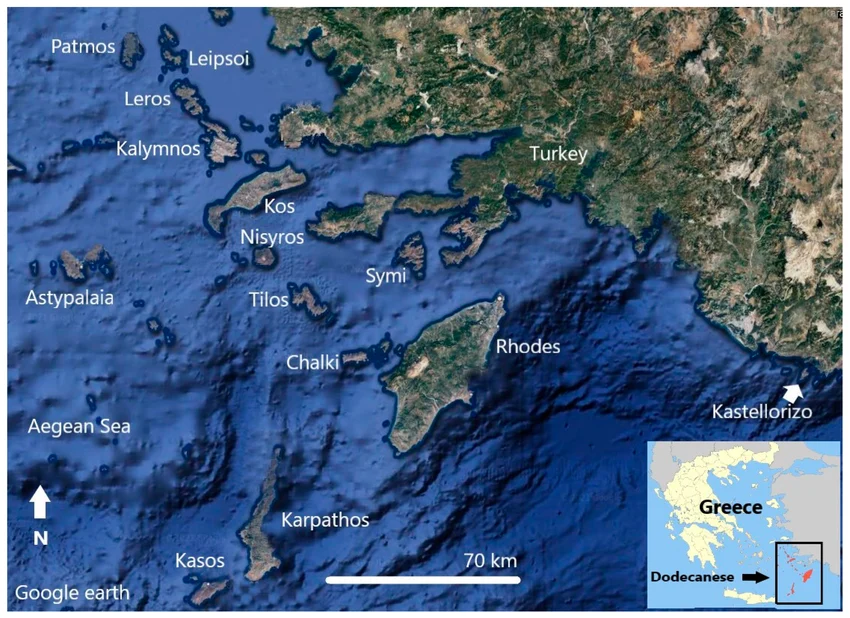
Çiğli Air Base, located near Izmir, is another important military aviation facility. It also supports the wider Izmir aviation acilities and hosts the 121 Filo, operating T-38M aircraft, the 122 Filo, operating KT-1T aircraft, and the 124 Filo. Balıkesir Airbase supports F-16 operations associated with the 9th Air Wing, providing a capable fighter force that can undertake a broad spectrum of missions. The Bandırma facility, home to the 6th Air Wing and additional F-16 assets, is also of considerable importance to Turkey’s ability to conduct air operations in the western part of the country.The air base at Datça is particularly noteworthy because of its geographical proximity to Rhodes and the Dodecanese. It supports T-38M Talon aircraft and therefore contributes to the wider network of aviation infrastructure available in the region.
Another important capability is provided by the 5th Main Jet Base at Merzifon, where the 151 Filo, known as the “Vultures,” operates the F-16 in a Suppression of Enemy Air Defences (SEAD) role. The squadron is associated with the employment of AGM-88 HARM missiles and performs missions including SEAD, Combat Air Patrol, and Quick Reaction Alert. Although Merzifon is located at a considerable distance from the Dodecanese, its operational relevance should not be underestimated. The availability of aerial refueling through Turkey’s KC-135R fleet increases the flexibility and endurance of Turkish fighter operations, allowing aircraft based further inland to operate over the Aegean for extended periods. The T-38M Talon has comparatively limited combat capabilities, but it can contribute to training, interception-related activities, and support missions. It may also perform roles associated with the protection or escort of transport aircraft and helicopters. The F-16, by contrast, represents a substantially greater threat because of its ability to conduct air-superiority, interception, strike, and SEAD missions. When equipped with AGM-88 HARM, it can specifically target enemy air-defence radars and associated systems.
Overall, the Turkish Air Force represents a significant factor in the regional military balance. Turkey possesses a substantial network of air bases and supporting infrastructure capable of facilitating sustained air operations over the Aegean and the Dodecanese. As noted above, the country’s aerial-refueling capability is particularly important because it allows combat aircraft to operate effectively over considerable distances and reduces their dependence on bases located immediately adjacent to the operational area. The Turkish Air Force’s air-transport capabilities also contribute significantly to this flexibility. The 11th and 12th Air Transportation Commands, based in Kayseri, provide an important strategic and tactical airlift capability. Turkey operates a fleet that includes approximately around 41 CN-235 aircraft, providing the ability to rapidly redeploy personnel, equipment, and specialized forces. Strategic airlift is further supported by additional heavy transport capabilities such as one C-17 and 10 A400M Atlas aircraft.
This airlift capability is particularly relevant when considering Turkey’s airborne mobility and its ability to redeploy specialized ground formations. These include the 1st, 2nd, 3rd, and 4th Commando Brigades, based respectively in Kayseri, Siirt, Bolu, and Tunceli; the Zıpkınlar Commando Regiment in Muğla; and the Mountain and Commando Brigade in Hakkari. Turkey also maintains Special Forces formations, including the 7th and 11th Special Forces Brigades in Denizli and Sakarya, as well as additional Special Forces and Jandarma formations in western and southeastern Turkey. Other relevant formations include the 23rd Internal Security Brigade at Şırnak/Silopi, the Training Division at Etimesgut, and the 1st Infantry Brigade in Manisa.
Although many of these formations are primarily infantry organizations, Turkey’s extensive air-transport infrastructure allows personnel and equipment to be rapidly redeployed to different areas when required. This provides Ankara with a degree of strategic and operational mobility that is particularly relevant to the Aegean environment. Turkey also possesses an extensive network of civilian airports that could potentially contribute to military mobility and logistical support. Of particular geographical relevance to the Dodecanese are Milas-Bodrum, Adnan Menderes, Çardak, and Dalaman, while Antalya and Isparta provide additional aviation infrastructure farther to the east.
Although these facilities are primarily civilian airports, their infrastructure could provide additional capacity for the rapid movement and redeployment of military personnel and equipment, particularly in a contingency requiring the movement of Commando or Special Forces units toward the western coastal region. Turkey’s helicopter fleet further enhances this mobility. It includes AS532 Cougar, Sikorsky S-70 Black Hawk, T-70, and CH-47 Chinook helicopters in well over a hundrend while attack-helicopter capabilities are provided by the TAI/AgustaWestland T129 ATAK. Turkey operates a substantial number of T129s, with additional aircraft having been ordered. The T129 ATAK has a reported maximum speed of approximately 281 kilometers per hour, a range of around 537 kilometers, and a ferry range of approximately 1,000 kilometers. It can be armed with a 20 mm cannon and carries multiple external weapon stations capable of employing anti-tank guided missiles and guided rocket systems. Taken together, Turkey’s network of air bases, aerial-refueling assets, transport aircraft, helicopters, and specialized ground formations provides Ankara with considerable operational mobility. This infrastructure allows forces stationed in the interior of the country to be rapidly redeployed toward the western coastal region and, where operational circumstances permit, employed in support of military operations in the Aegean and surrounding areas.
The amphibious forces represent another important component of Turkey’s military capabilities, operating in conjunction with the naval forces. Turkey’s amphibious-warfare capabilities are extensive, however their role would become particularly significant in the context of a major confrontation. Their principal utility would be associated with large-scale offensive operations aimed at seizing or controlling one of the larger islands of the Dodecanese. The TCG Anadolu amphibious assault ship could also constitute an important asset in asymmetric and expeditionary operations. It can accommodate a substantial number of helicopters, including attack and transport helicopters, and could potentially support special-operations missions against targets in the vicinity of Rhodes or against smaller islands. Its aviation capacity could also be used to support unmanned aerial systems for surveillance, reconnaissance, and other missions. The Anadolu is supported by a substantial amphibious capability, including landing craft capable of transporting heavy equipment and armored vehicles, as well as smaller mechanized landing craft for operations in more confined environments. It can also operate in conjunction with coastal and fast patrol vessels, which could support a range of maritime security and asymmetric missions. It can carry as many as 30 helicopters like the Cobra attack helicopter, or to transport special operations helicopters that can stage various operations against the territories adjust to Rhodes or against smaller islands in a same type operation as the Imia that took place in 1996. It can also carry alternatively some 50 UAVs that can also be used against a variety of operations It has 29 Landing Craft tanks of 600 to 1150 tones that can used in carry heavy armor in some islands of small size and some Landing craft Mechanized of 113 tones that can be used in smaller. It has some 7 Coastal & Fast Patrol ship that can be used for underwater and other asymmetric operations.
The Turkish navy is quite capable for such operations and has a large number of units that can perform both in major landing operation as and some that can be used in asymmetric warfare operations. It has 29 Landing Craft Tank of the 600 to 1300 tones and some Landing Craft Mechanized in the number of 6. For major operations it includes some 5 Landing Ship Tanks of 2.600 to over 7.000 tones that can perform major operations of tank and armored vehicles. In general the smaller types of amphibious operations boats can perform duties similar to asymmetric warfare against islets and rock islands, while in case of a major sea assault the Landing Tank Ships can carry heavy reinforcements against the larger islands with the support of Anadolu in one of them. A strong naval force in order to support her complement those amphibious forces. The Atilay, Preveze and Gur class are submarine of 1.100 to 1.500 tones that operate in the small depths of the Islands Archipelago of the Aegean. There are capable submarine that carry modern torpedo as and Harpoon missiles to a total number of 14 plus a number of mines. As such it can perform area denial operations as and perform mine deployment operations.
Regarding operations in the Aegean, Turkey possesses a number of naval units designed to operate effectively in the relatively confined and complex waters of the archipelago. The Tuzla-class vessels are primarily intended for coastal patrol and maritime-security missions, including operations around gulfs, ports, and naval bases. Their characteristics make them suitable for operations in restricted waters. Turkey also operates a number of fast attack and missile boats equipped with anti-ship missiles, medium-caliber naval guns, and short-range air-defence systems. Such vessels are particularly suited to asymmetric maritime operations in the Aegean, where their speed and relatively small size can provide advantages in coastal and littoral environments. Those are 17 fast attack boats, missiles boats, armed with 8 Harpoon missiles, 76 Otomelara cannon as and dual 35 and 40 mm anti aircraft gun. Very capable to wage an asymmetric warfare in the Aegean with Hit and Run and ambuse tactics as and complete the submarine fleet in the area denial operation or deny access. The 10 offshore Hisar Patrol boats at 2.500 tones are also another type of ship designed for the Aegean armed with 76 mm cannon, 8 air defence missiles and 8 anti ship missiles. It is complemented by 5 older but capable Estiene De Orves frigates with 4 Exocet, 100 mm gun and 6 ASW 375 mortar. The four ADA class complete the fleet with extended ASW capabilities and RAM system.
Their employment can complement Turkey’s submarine force and contribute to broader sea-denial and access-denial capabilities. The Hisar-class offshore patrol vessels represent another component of Turkey’s Aegean naval capability. These relatively large patrol vessels are equipped with naval guns, air-defence systems, and anti-ship missiles, giving them a broader range of capabilities than conventional patrol vessels. They are complemented by older but still capable French-designed Estienne d’Orves-class vessels, which retain anti-ship and anti-submarine capabilities. The four Ada-class corvettes provide an additional layer of capability, particularly in Anti-Submarine Warfare (ASW), while also incorporating point-defence capabilities through systems such as RAM.
For major operation there are 17 plus 7 on order Frigates, modernized with Anti Air Warfare capabilities up to 50 to 60 kilometers, CIWIS systems, Surface t Surface missiles and extended ASW capabilities. Very capable units that can perform major naval engagment between fleet divisions and escort duties. Those are the MEKO class, Oliver Hazard and the Turkish made Instabul class. The Turkish navy also operates 15 Maritime Patrol Aircraft of the ATR-72, CASA CN 235 & ATR 72 under the projects MELETM I,II & III that can perform ASW, anti surface open7rations as and ISR operations in conjuction with fleet and the other means of the Turkish Armed Forces, as and 22 SikorskS-70 Seahawk helicopters that can perform ASW and Anti ship operations.
For larger-scale naval operations, Turkey possesses a fleet of modernized frigates, including MEKO-class vessels, Oliver Hazard Perry-class frigates, and the domestically produced Istanbul-class frigates. These ships provide capabilities across a broad range of missions, including Anti-Air Warfare (AAW), anti-surface warfare, Anti-Submarine Warfare, fleet escort, and major surface engagements. Their modernization has increased their air-defence capabilities and improved their ability to operate as part of larger naval formations. The Turkish Navy’s maritime capabilities are further reinforced by approximately 15 maritime patrol aircraft, including ATR-72 and CASA CN-235 platforms operated under the MELTEM I, II, and III programmes. These aircraft can conduct ASW, anti-surface, maritime surveillance, and Intelligence, Surveillance and Reconnaissance (ISR) missions in coordination with surface vessels, submarines, aircraft, and other elements of the Turkish Armed Forces. The fleet is also supported by approximately 22 Sikorsky S-70 Seahawk helicopters, which provide additional ASW and anti-surface capabilities and can operate in conjunction with surface combatants.
Beyond the lighter special-forces formations, one of the central components of the military force positioned for operations against the Greek islands is the Turkish Aegean Army. It includes a substantial number of specialized and elite formations, together with additional conventional units such as the 19th Motorized Infantry Brigade in Edremit, the 57th Artillery Brigade in Izmir, and the 3rd Amphibious Marine Brigade at Foça.The Turkish Naval Forces also maintain specialized underwater warfare capabilities. The Underwater Offence teams constitute a further special-operations element associated with the Turkish naval command structure. Their mission set includes covert operations, reconnaissance, sabotage, and raids against strategic facilities in maritime, coastal, and land environments.
Taken together, these forces provide Turkey with a broad range of capabilities that it can use for operations in the Dodecanese of any form they consider appropriate. These include area surveillance and control, the employment of unmanned systems for battlespace awareness and command-and-control support, and specialized missions involving EW, ISR, and ASW. The integration of these capabilities with conventional naval and air assets could create a complex operational environment in which relatively small unmanned and manned platforms support larger naval formations. Such an architecture could contribute to sea denial, surveillance, intelligence collection, and other asymmetric operations.
The proximity of Turkish airports and military facilities to the Dodecanese provides additional operational flexibility. These facilities could support the rapid movement of personnel and equipment, while Turkey’s helicopter fleet provides an additional means of mobility for specialized and light forces. In a contingency, these capabilities could support a range of air-mobile and special-operations missions. Turkey’s amphibious capabilities provide a further dimension for larger-scale operations. Landing ships and craft can transport heavier equipment and personnel and therefore provide capabilities beyond those available to special-forces and light-infantry formations.
Overall, Turkey possesses a significant range of military capabilities that could be employed in the Aegean across the maritime, air, land, and information domains. One of the most important characteristics of this force is the integration of conventional platforms with increasingly sophisticated unmanned systems. The unmanned fleet is particularly relevant because it can provide persistent ISR, Electronic Warfare, and ASW capabilities across relatively large areas by getting dispersed and creating a network that can cover the whole area. Operating in conjunction with manned naval platforms, submarines, maritime patrol aircraft, and combat aircraft, these systems can contribute to a layered approach to surveillance and creaet sea and area denial situation.
The Turkish Navy can conduct the principal maritime missions through its submarines, major surface combatants, corvettes, patrol vessels, and unmanned systems. At the same time, airborne C4I and surveillance platforms provide a broader command-and-control architecture capable of supporting operations across the air, maritime, and land domains. Turkey’s extensive transport-aircraft fleet, combined with its large network of military and civilian airports, provides substantial strategic and operational mobility. These capabilities allow specialized and light forces to be redeployed rapidly within the country. The helicopter fleet, including attack helicopters, provides an additional layer of mobility and support. For heavier operations, Turkey’s amphibious ships and landing craft provide the capacity to move larger quantities of personnel, equipment, and armored assets. This gives Ankara an additional capability for conducting operations that exceed the scope of conventional special-forces or light-infantry missions. This is one of the corn stone of the Turkish military power. Quite excellent in many aspects with over all capabilities in every aspect of warfare the creation of a network of rapid deployment is what does allow to deploy its forces any were at any time. A large range of airports spread all over Turkey does allow her to deploy her forces in the point of confrontation that Turkey desires at the appropriate level and for the duration it desires. That is one of the advantage of the Turkish Armed Forces a lwide network of installations that can allow the deployment and redeployment of forces as and their support with a number of means. It has a series of support ships that include two Replenishment tanker of 8.500 tonnes plus two Akar class of 19.350 tonnes and one of TCG Derya of 26.000 tonnes which is an Auxiliary ship. It is also includes five smaller of 3.200 tonnes.
In broad terms, the combination of C4I infrastructure, ISR and SIGINT capabilities, Electronic warfare systems, unmanned platforms, submarines, surface combatants, air assets, transport aircraft, helicopters, and amphibious forces creates a multidimensional military architecture. The principal significance of this architecture is not necessarily the individual capability of any single platform, but rather the potential integration of multiple systems across different domains. Such integration could allow Turkey to establish persistent surveillance, increase situational awareness, conduct sea-denial and access-denial operations, and support asymmetric activities across the Aegean. In a crisis, the combination of these capabilities could provide Turkey with significant operational flexibility and the ability to rapidly alter the military situation in a localized area. The proximity of the Turkish military infrastructure to the Dodecanese, combined with the country’s extensive naval, air, amphibious, and special-operations capabilities, therefore constitutes an important factor in any assessment of the regional military balance.