





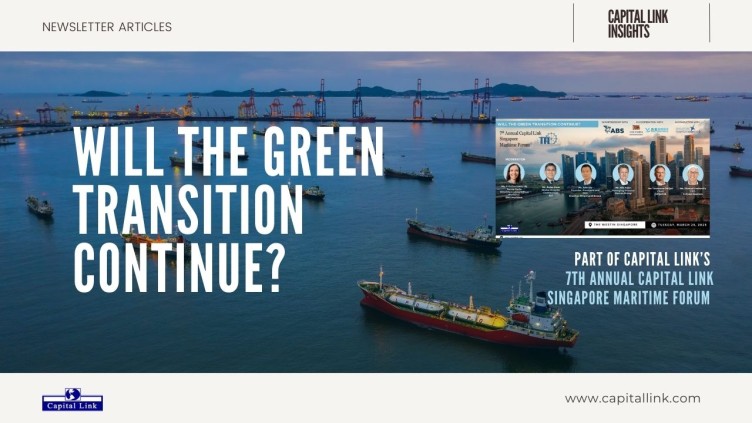
At the 7th Annual Capital Link Singapore Maritime Forum, industry experts gathered to discuss a pressing question, Will the green transition continue? Moderated by Cristina Saenz de Santa Maria, COO of Maritime at DNV , the discussion featured insights from Peter Liew , Global Director, Commercial at AET , John Su, Founder, President and CEO at Erasmus Shipinvest Group , Nils Aden , Managing Director at Harren Group , Laurence Odfjell , Chair at Odfjell SE and last but not least Shmuel Yoskovitz, CEO at X-Press Feeders, who talked about new regulations, fuel choices, and geopolitical uncertainties paving the way towards decarbonization.
Regulatory Pushback
During the discussion, the EU’s Emissions Trading System (ETS) and FuelEU Maritime regulations faced mixed reactions from the panelists. Mr. Su called the EU’s policies messy and questioned their global enforceability, noting that only Europe acting alone cannot possibly change things. Mr. Su revealed his company has deliberately diversified into smaller vessels (including sub-5,000 dwt LPG carriers) to avoid EU scrutiny. Meanwhile, Mr. Aden commented that while retrofits and energy-saving devices deliver double digit IRRs with payback in 18 to 36 months, a widespread green fuel adoption may lag until the 2030s without subsidies or punitive taxes on conventional fuels.
Additionally, Mr. Aden, whose company operates bio-methanol fueled vessels, revealed that only one client (Evergreen) was willing to pay the premium. “The price difference is 3.5 to 4 times per energy unit. You can’t be the only one doing this,” he said, criticizing the EU’s recent move to classify LNG as a green fuel as a setback for methanol adoption.
Alternative Fuels: A Leap of Faith
Despite this uncertainty, everyone agreed on the need for long-term bets. Mr. Liew for example, defended AET’s 14 dual-fuel methanol vessels (8 of which have already been delivered), emphasizing that partnerships with likeminded companies will help to share risk. “We stay laser-focused on our trajectory. If the playing field were level, decisions would be easier.” But Mr. Aden appeared skeptical, predicting that green fuels won’t scale until early 2030 without a miracle like nuclear derived ammonia. “We’ve burned bio-methanol, but I doubt we’ll still be doing it in two years” he mentioned.
Similarly, Mr. Odfjell pointed to Odfjell SE’s new methanol-capable tankers as a first step, even if methanol isn’t immediately viable, noting, “We have to move ahead, you can’t wait for perfect solutions. It’s a long-term bet. These ships will trade for 25–30 years.”
However, Mr. Yoskovitz argued that efficiency gains, such as X-Press Feeders’ fleet’s 53% reduction in emissions since 2004, 40% of which came from technical upgraded like hull optimizations, remain the most bankable temporary strategy. “Efficiency is good business. Payback is under two years” he said, urging owners to act now rather than wait to act later.
Mr. Liew countered, “I agree with all the panelists, but I feel that sometimes when it comes to fuel efficiency, are we coming to the end of the road as far as efficiency is concerned? These are all the low-hanging fruits, these are all the short-term. How much more can we push the efficiencies level before embarking into the real solutions or the more midterm to long-term solutions?”
Trade Wars and Fragmentation
As always, geopolitical tensions cast a shadow over the discussion. Mr. Aden warned the panel that U.S. trade policies on Chinese goods could dampen consumer demand for container shipping, while Mr. Su lamented once again the lack of unified global regulations, noting “We’re in a wartime economy. How can we talk about green fuels when countries are still recovering from conflict?”
Through the skepticism, Mr. Odfjell shared a breakthrough, their chemical tanker With Orca, retrofitted with Bound4Blue suction sails, is attempting a zero-emission Atlantic crossing using 100% renewable fuel. “Simulations show 10% fuel savings from sails alone. This proves zero by 2050 is possible.” he announced.
Concluding, Ms. Saenz de Santa Maria stressed that any possible solutions must be good for business. While efficiency gains are proven, green fuels remain hostage to policy chaos and cost gaps. As Mr. Aden put it, “The world isn’t catching up. We might even go backward.”
To watch the full conversation please visit the following link: