






Capital Link Insights
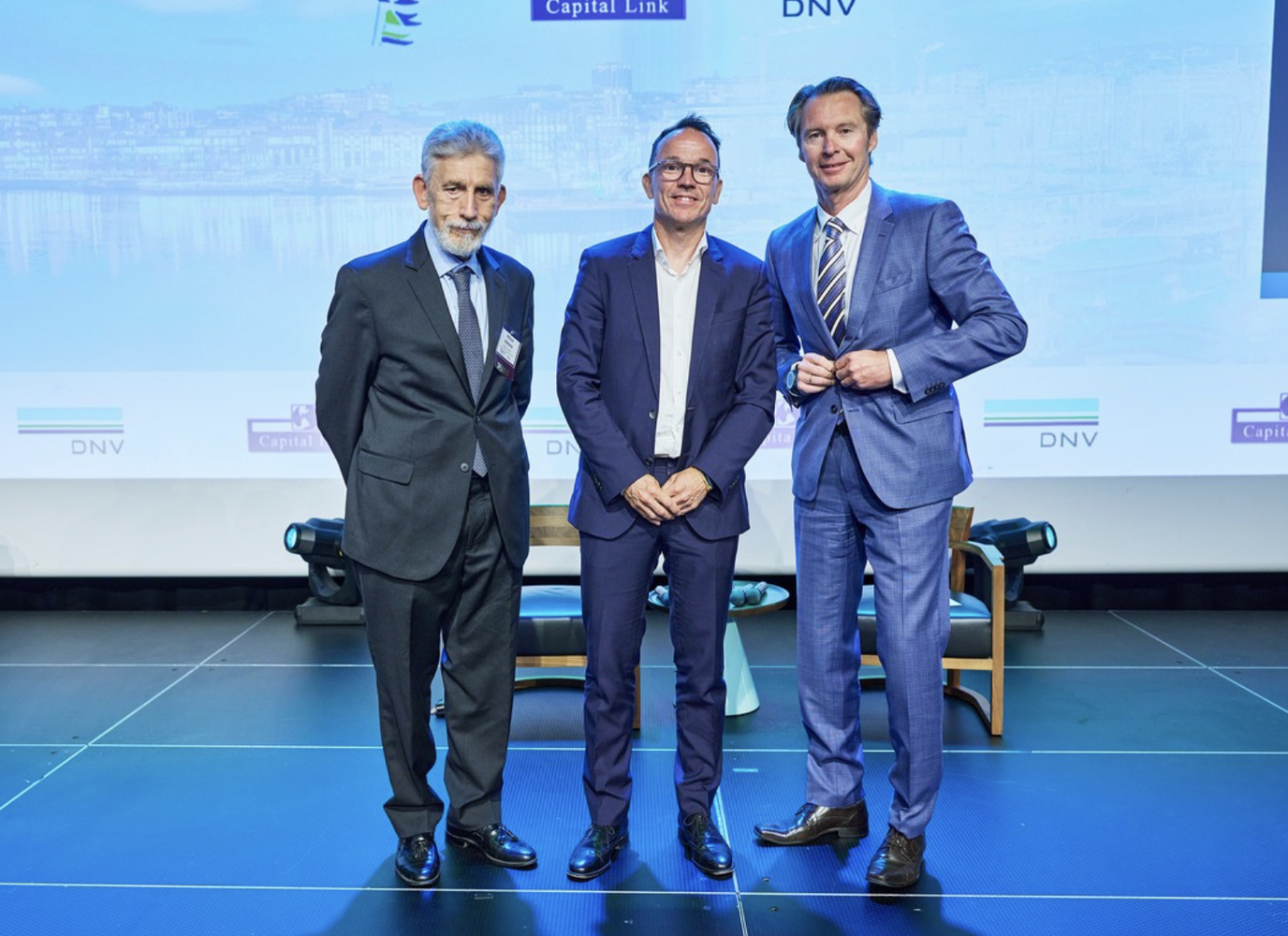
The 2nd Maritime Leaders’ Summit, featured an on-on-one discussion between Mr. Knut Ørbeck-Nilssen, CEO at DNV – Maritime and Mr. Jan Dieleman, President at Cargill Ocean Transportation, and Chair at Global Maritime Forum who delved on critical issues shaping the future of shipping, from geopolitical disruptions to sustainability and technological advancements.
The summit co-hosted by Capital Link and DNV, took place within the context of Nor-Shipping Week in Oslο. Drawing a record attendance of over 600 industry professionals, the event brought together senior executives from 22 leading shipping companies and featured a high-caliber lineup of industry leaders.
Geopolitical Turmoil
In the current climate, geopolitical instability is reshaping trade. Although tariffs and trade conflicts are not new, their frequency and intensity have increased, creating structural shifts rather than temporary disruptions, according to Mr. Dieleman. For example, U.S. soybean exports shifted to Brazil overnight due to the tariffs imposed by the U.S., thus demonstrating rapid adaptability.
This adaptability comes at a cost though, proving that not all regions can be easily substituted. The Black Sea, for instance, has become inaccessible for mainstream shipping outside of Ukrainian grain corridors, removing a major player for global food and commodity trade. This exclusion not only disrupts immediate cargo flows but also reduces market transparency, making it harder for operators to anticipate price movements and adjust their positioning accordingly.
As a result, the new trade corridors and the potential for long-term realignment raise questions about the resilience of the current shipping networks. Mr. Dieleman noted that larger operators with diverse fleets are better equipped to absorb these shocks, commenting that industry consolidation will accelerate as smaller players struggle with regional changes. The main concern, however, is whether trade growth, historically key factor of shipping demand, will continue at its previous pace. “We are not only talking about bumps in the road, but things that might even change trade patterns, the way business is being carried out” Mr. Ørbeck-Nilssen added.
The Dilemma of Newbuild Investments
The IMO’s revised GHG strategy has turned decarbonization into one of the most pressing challenges for the sector. Mr. Dieleman advised that voluntary measures alone cannot be sufficient; binding regulations are necessary to drive industry-wide change. Asset prices remain high relative to charter returns, and the lack of clarity around the U.S. sanctions and IMO implementation details has resulted in a reluctant approach to newbuild investments.
In April, during the MEPC 83 meeting, the U.S. withdrew from negotiations, whilst many countries either voted no or abstained from voting. Regardless, the regulation came through, albeit with no consensus, and is expected to be adopted in October if it reaches a two-thirds majority and 50% tonnage approval, Mr. Ørbeck-Nilssen says. Some of the measures include carbon pricing mechanisms as well as the governance of a proposed decarbonization fund. Mr. Dieleman believes that the revised strategy will be adopted after all but stressed that the real work will lie in the technical details, like lifecycle analysis frameworks and the equitable distribution of funds.
In the meantime, retrofitting existing vessels appears to be a logical approach, given the inevitability of rising fuel costs and tightening regulations. Nevertheless, the question of cost-sharing between charterers and shipowners along with the value chain remains. While some charterers, like Cargill, have taken a proactive stance by financing efficiency upgrades in exchange for fuel savings, broader industry alignment on risk allocation is still lacking. Mr. Dieleman added that for vessels ordered today (especially those with delivery dates in 2028 or later) the 2030 emissions deadline becomes a major concern. If the IMO’s trajectory becomes stricter, these ships could face early obsolescence or costly retrofits.
Additionally, many players still operate under short-term time charters, making it impractical to liquidate retrofit costs. Others lack the data transparency to verify fuel savings, leading to disputes over performance guarantees. Mr. Dieleman suggested that some standardized mechanisms that could bridge this gap would include shared savings contracts, where owners and charterers split efficiency gains, green clauses in charters that formalize retrofit cost-sharing, and third-party verification of performance improvements to build trust. Mr. Ørbeck-Nilssen commented that the case for retrofitting isn’t just economic, but fundamentally about future-proofing assets.
The Dark Fleet’s Shadow
The dark fleet, though a persistent problem, has gained the reputation that it exists in a separate ecosystem. Mr. Dieleman challenges that, pointing out that these vessels share the same waterways, ports, and supply chains as compliant ships. This overlap raises safety and environmental concerns, as many of these vessels are older and poorly maintained.
He suggested that a reduction in geopolitical tensions could potentially reintegrate some of these ships into mainstream operations, mostly those that meet technical standards. Further than that, sustained low freight rates could incentivize scrapping, but in the absence of such pressures, these ships will most likely continue to operate in the shadows.
From Hyping AI to Practical Application
While much of the industry’s focus has been on decarbonization, digital transformation is quietly reshaping the scene as well. Right now, rather than revolutionary overhauls, companies are implementing AI incrementally, targeting specific pain points like route optimization, predictive maintenance, emissions monitoring, etc.
This approach, Mr. Dieleman argues, is more sustainable than previous cycles of hype, it allows operators to gradually implement technologies without requiring wholesale intervention. Finally, he noted that there has been tangible progress in areas like data-driven chartering decisions and voyage efficiency, where AI tools are delivering measurable value.
To watch the full conversation please visit the following link:
https://www.linkedin.com/pulse/steering-through-change-four-forces-reshaping-global-shipping-a6swf/