






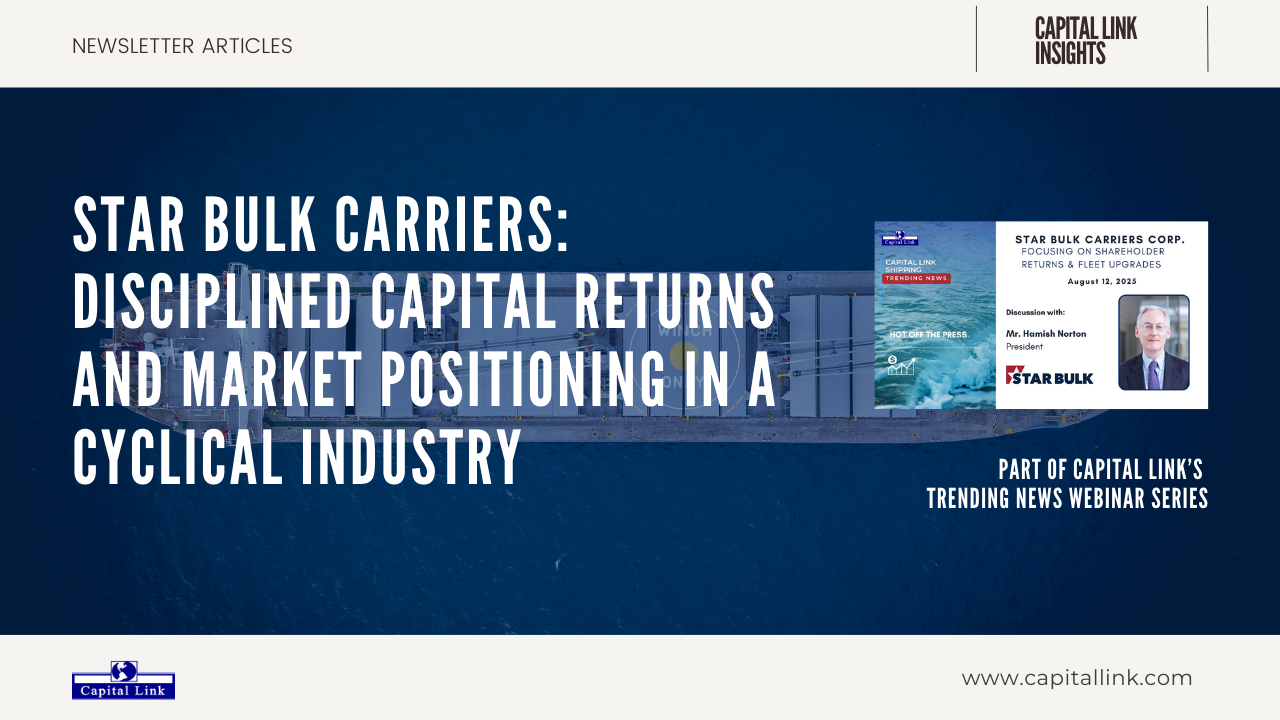
In this episode of Capital Link’s Trending News Webinar Series, Star Bulk Carriers (NASDAQ: SBLK) President Mr. Hamish Norton offered his insights and a strategically detailed look at how the company approaches shareholder value creation through disciplined capital allocation. The discussion revealed a consistent theme: Star Bulk makes capital deployment decisions anchored in measurable returns, with a readiness to adapt to shifts in asset pricing, freight rates, and regulatory pressures.
To watch the full webinar, please visit the following link:
Investor Snapshot
- $2.75B returned to shareholders since 2021 — dividends, buybacks, debt reduction.
- 3.3M shares repurchased in Q2 2025 for $54M, funded largely by vessel sales.
- Dividend policy: ~60% of operating cash flow; Q2 dividend of $0.05/share.
- Strong liquidity: $407M cash + $115M undrawn revolver; net debt $761M.
- Fuel efficiency upgrades across the fleet to cut operating costs and meet emissions rules.
- Supply-side support: Global orderbook at ~10.8% of fleet; 28% of vessels over 15 years old.
- Market tailwinds: Seasonal trade strength, Chinese restocking, and new long-haul iron ore flows from Brazil and Guinea.
Fleet Upgrade Strategy
Star Bulk continues to invest in efficiency improvements that reduce fuel consumption, enhance environmental compliance, and extend vessel competitiveness. In Q2 2025, the company fitted three vessels with energy-saving devices (ESDs) and high-efficiency propellers, bringing the total to 47 installations, with 13 more planned for 2025. Other initiatives include low-friction hull coatings, robotic hull-cleaning systems, and advanced weather-routing technology. These measures, alongside five newbuilding Kamsarmax vessels scheduled for 2026 delivery, are designed to achieve fuel savings of 10–15% while ensuring compliance with tightening IMO carbon regulations.
Capital Return Policy: Dividends, Buybacks, and Financial Discipline
Since 2021, Star Bulk has delivered $2.75 billion in total shareholder value creation — $1.4 billion in dividends, $518 million in share buybacks, and $876 million in debt repayment. The company’s framework blends steady dividends with opportunistic buybacks, underpinned by ongoing debt reduction and a focus on liquidity.
A central principle in this approach is what Mr. Norton terms “pure arbitrage”: using vessel sale proceeds to repurchase shares when they trade at a significant discount to net asset value (NAV). This turns the pricing gap between asset sales and share repurchases into a direct gain for shareholders. In Q2 2025, Star Bulk repurchased approximately 3.3 million shares for $54 million, funded largely by the sale of nine older, less efficient vessels, which generated equity proceeds of about $82.1 million (with $50.6 million to be received in H2 2025). The company renewed its $100 million share repurchase authorization in the quarter.
Dividends remain a core element, with the company declaring $0.05 per share for Q2 2025 (record date August 28th) and maintaining a policy of paying out approximately 60% of operating cash flow. This provides reliable income to shareholders, a priority for both board and non-board large investors.
Debt reduction reinforces this capital return policy. Star Bulk amortizes around $250 million annually without refinancing, which has brought net debt down to $761 million as of August 4, 2025 — well covered by the fleet’s scrap value of $932 million. Cash stood at $407 million, with an additional $115 million in undrawn revolver capacity, giving the company pro forma liquidity in excess of $520 million.
As Mr. Norton explained, when shares are “ridiculously low,” operating cash can be used for buybacks; when valuations approach NAV, liquidity is preserved for future opportunities. This flexibility ensures shareholder returns are value-accretive rather than formulaic.
Market Outlook: Tight Supply, Seasonal Strength, and Strategic Deployment
Supply Side Fundamentals
According to Clarkson data presented in Star Bulk’s Q2 report, the dry bulk orderbook remains low at ~10.8% of the fleet (~113.2 million dwt). High shipbuilding prices, limited yard space due to competing vessel types, and uncertainty over future propulsion technologies are constraining new orders. About 27.7% of the global fleet is over 15 years old, and increased special surveys and dry docks are expected to trim effective capacity by more than 0.5% annually through 2027. Regulatory compliance is also prompting slower steaming, further reducing available supply.
Demand Drivers
On the demand side, Mr. Norton highlighted the “ocean imbalance” — with more ships in the Pacific and fewer in the Atlantic — which has supported rates and is likely to persist, though less strongly, into early 2026. Star Bulk positions vessels to capture Atlantic exposure during peak imbalance periods.
Seasonality should provide additional support. Historically, the second half of the year accounts for 54% of dry bulk trade versus 46% in the first half. In 2025, Star Bulk expects a stronger-than-usual H2, driven by Chinese restocking of coal and grain inventories, Brazilian iron ore seasonality, and the commencement of long-haul shipments from Guinea’s Simandou mine in Q4 — a development expected to materially boost ton-mile demand.
The company also noted record export volumes in June 2025, partly due to cargoes expedited ahead of tariffs. While Star Bulk’s direct exposure to tariffs is limited, Mr. Norton cautioned that slower global GDP growth from trade restrictions could indirectly weigh on demand. Conversely, he sees upside potential from post-conflict reconstruction, noting, “It’s astonishing how much dry bulk you need to reconstruct cities.”
2026 Outlook
Star Bulk projects dry bulk trade growth of +0.3% in tons and +0.6% in ton-miles for 2026. Key cargoes include a rebound in high-quality Atlantic iron ore exports, steady grain ton-miles, and sustained minor bulk growth, particularly bauxite from West Africa. Combined with limited fleet growth and ongoing slow steaming, the supply-demand balance is expected to remain favorable.
Positioned for Cyclical Resilience
Star Bulk’s positioning reflects a deliberate alignment of capital returns, operational efficiency, and market strategy. The company’s capital return framework ensures shareholder distributions are both sustainable and opportunistic, its fleet upgrades preserve competitiveness under evolving regulations, and its chartering strategy aligns asset deployment with seasonal and structural trade flows.
By focusing buybacks on periods of deep NAV discounts, maintaining a reliable dividend policy, and preserving liquidity for opportunistic investments, Star Bulk is managing both upside potential and downside protection. As Mr. Norton concluded, “We think Star Bulk is an exceptional opportunity as currently priced” — a conviction rooted not in short-term optimism, but in a proven, disciplined approach to capital allocation that has delivered results across market cycles.
About Star Bulk
Star Bulk is a global shipping company providing worldwide seaborne transportation solutions in the dry bulk sector. Star Bulk’s vessels transport major bulks, which include iron ore, minerals, and grain, and minor bulks, which include bauxite, fertilizers, and steel products. Star Bulk was incorporated in the Marshall Islands on December 13, 2006, and maintains executive offices in Athens, New York, Stamford, and Singapore. Its common stock trades on the Nasdaq Global Select Market under the symbol “SBLK”. On a fully delivered basis and as adjusted for the delivery of a) the vessels agreed to be sold and b) the five firm Kamsarmax vessels currently under construction, Star Bulk owns a fleet of 142 vessels, with an aggregate capacity of 14.2 million dwt consisting of 17 Newcastlemax, 15 Capesize, 1 Mini Capesize, 7 Post Panamax, 42 Kamsarmax, 1 Panamax, 48 Ultramax, and 11 Supramax vessels with carrying capacities between 55,569 dwt and 209,537 dwt. In addition, in November 2021, Star Bulk took delivery of the Capesize vessel Star Shibumi, under a seven-year charter-in arrangement, and in 2024, Star Bulk took delivery of the vessels Star Voyager, Star Explorer, Stargazer, Star Earendel, Star Illusion, and Star Thetis, each subject to a seven-year charter-in arrangement.