



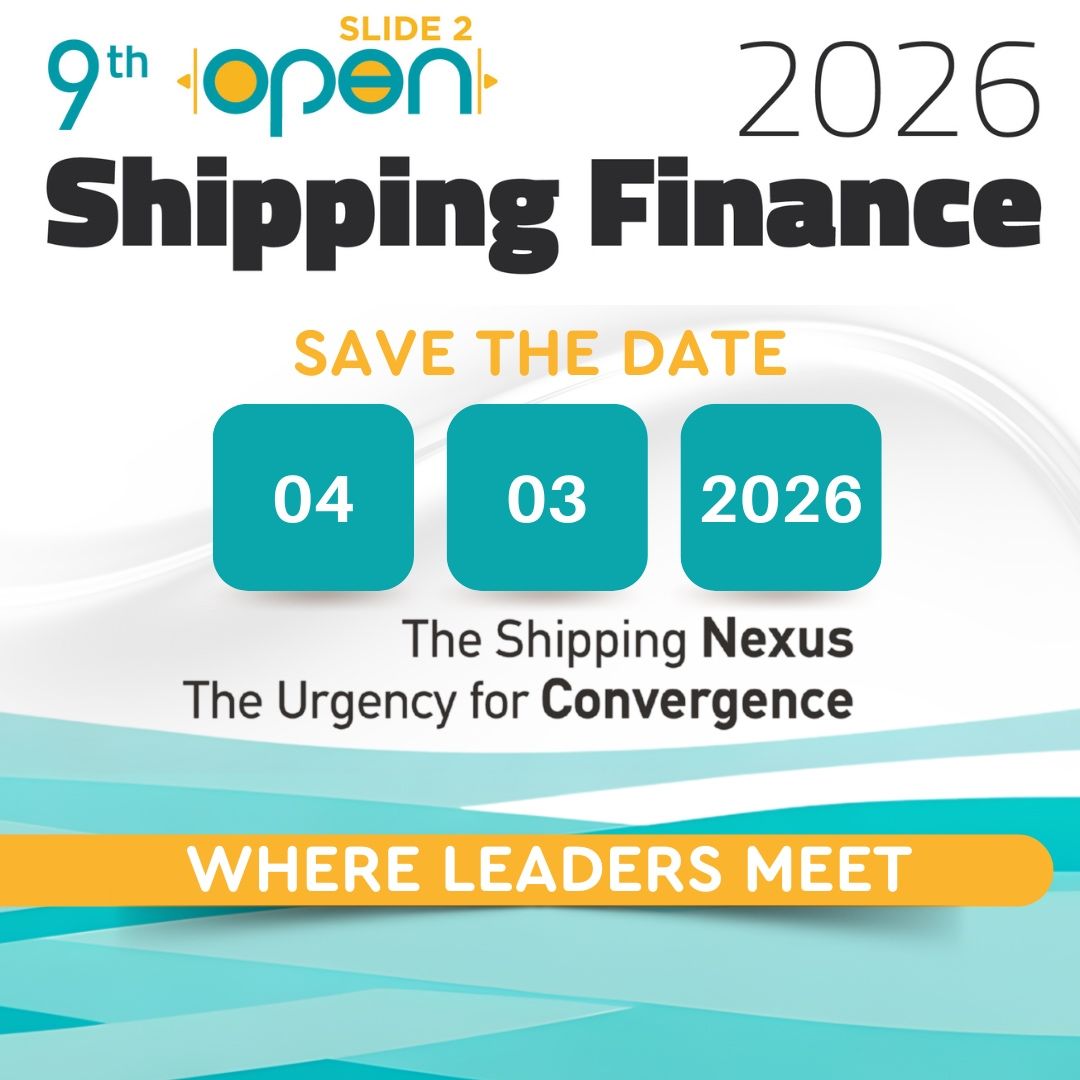
The 9th Slide2Open Shipping Finance Conference 2026 returns at a defining moment for global shipping.
4 March 2026
Athens
9th Slide2Open Shipping Finance 2026
Weaponized Tides
Trade as the new Weapon and Oceans as the Frontline
The Shipping Nexus
The Urgency for Convergence
High Impact Networking Conference
- A unique experience where keynote presentations, interviews, and panel discussions seamlessly blend with workshops, and networking breaks.
- A gathering of top shipping executives where exclusive networking opportunities abound.
• An interactive conference featuring innovative, insightful, thought-provoking content
Don’t Miss Keynote Speaker
Dr Louise Tumchewics
Research Fellow, Centre for War Studies, University of Southern Denmark; Visiting Research Fellow, King’s College London;
Assistant Professor, Rabdan Academy
on Weaponized Tides: Trade as the New Weapon and Oceans as the Frontline
Navigating the Geoeconomic Shift and the Future of Maritime Resilience
The era of free trade is yielding to a complex geoeconomic order where commerce is no longer just an economic activity, but a primary tool of foreign policy. Dr. Louise Tumchewics explores this “weaponization” of trade—from the strategic implementation of tariffs and sanctions to the rise of protectionist measures—and analyses whether these tools effectively achieve their geopolitical goals. As major powers like China, the EU, and India recalibrate their strategies within an “unpolar” world, the maritime industry finds itself on the frontline of these shifting global corridors. This keynote maps the consequences of this fragmentation and provides a strategic outlook on how shipping must adapt its operations and fleet deployment to remain resilient in a world defined by geoeconomic friction.
Key Points Addressed
The Geoeconomic Pivot: Analysing the transition from global free trade to the strategic use of trade as a foreign policy weapon.
Feasibility & Outcomes: A critical evaluation of whether protectionist and restrictive trade measures achieve their real-world geopolitical objectives.
The Power Response: How major global players—China, India, the EU, and Russia—are forced to adapt their trade policies under current geopolitical constraints.
Reshaping the Map: Examining the near-term and long-term consequences for global trade patterns and the maritime “Nexus.”
Strategic Adaptation: How the shipping industry can prepare for and adapt to a world of weaponized trade and shifting maritime corridors.
Don’t Miss Keynote Speaker
Dr Arnab Das
Global Economic Counsellor & Macro Strategist on
Canary in the Gold Mine: Global Reordering into an “Unpolar” World Order
The Strategic Pre-emption of US Dominance and
the New Metrics of Global Power
Historically, global reorderings follow major conflicts or industrial revolutions; however, we are currently witnessing a pre-emptive attempt by the US to restructure the international system before it becomes over-extended. Arnab Das examines why the US, facing peer competition from China in technology and economic scale, and Russia in military capabilities, is moving toward an “Unpolar” world—a fragmented landscape where no single power holds absolute sway. This shift is signalled by the “Canary in the Gold Mine”: a sharp rally in gold and non-US assets that reveals an investor class desperate for diversification, yet tethered to a US safe haven that retains financial and AI dominance. This keynote offers a deep-dive into how businesses must navigate this stalemate of great power rivalry, balancing the risks of a shifting world order against the continued dynamism of the US economy.
Key Points Addressed
Pre-emptive Reordering: Analysing the US strategy to shore up its position as “first among equals” before a total loss of strategic peace.
The Peer Challenge: A comparative look at the economic, technological, and military capabilities of China and Russia versus the US.
The Gold Signal: Why the rally in gold and a weakening USD act as the “Canary,” signalling a lack of alternatives to the current global safe haven.
The Unpolar Stalemate: Understanding the “Stalemate of Power”—how diversity across metrics of influence prevents any one nation from achieving total dominance.
Strategic Diversification: How investors and maritime leaders can manage exposure to US leadership in Tech/AI while diversifying against geopolitical uncertainty.
Organizer’s Editorial
“For years, the shipping industry has been pressured to lead the green transition, responding with investment readiness and strategic resolve. Today, we face a paradox: while shipowners have shown a clear willingness to cooperate on sustainable solutions, the surrounding ecosystem, from regulators to energy producers, is now pausing to consider the inherent difficulties in implementing stringent guidelines and deadlines. At the 9th Slide2Open Shipping Finance Conference, we shift the narrative. Our goal is not just to discuss what shipping must do next, but how the entire ‘Nexus’ can urgently converge to provide the clarity required for global trade to thrive. Shipping has stepped up; now, the ecosystem must align. “
Despina Travlou
Managing Director, Slide2Open Communications
Maritime Ambassador, IEEE Standards Association
Overview
Shipping is the backbone of global trade, yet it currently faces a strategic impasse. After years of building consensus around ambitious climate goals, the late 2025 postponement of the IMO’s Net-Zero Framework has created a unique opportunity for all stakeholders to approach the transition with renewed realism.
This pause, while offering a moment for reflection, presents significant challenges. Shipowners are called to commit billions to newbuildings and propulsion systems amidst a fluctuating regulatory roadmap and an evolving fuel supply chain. Simultaneously, geopolitical shifts and longer trade routes are driving up operational costs, contributing to global inflationary pressures, and tightening tonnage supply.
Shipping is not diverging from its commitments; rather, the entire ecosystem is being challenged. The 9th Slide2Open Shipping Finance Conference serves as a catalyst for this essential alignment. We bring together shipowners, charterers, financiers, policymakers, shipyards, port authorities, classification societies, and technology leaders to bridge the gap between regulatory uncertainty and commercial reality. Our mission is to foster the renewed dialogue necessary to ensure shipping remains resilient, affordable, and climate aligned.
This is where urgency meets leadership
and where the next phase of maritime strategy takes shape.
Key Discussion Topics
The Cost of Inaction: Examining how regulatory pauses and technological development lags impact global inflation and market volatility.
The Post-IMO Landscape: Navigating the interplay between regional mandates (EU ETS/FuelEU) and global policy shifts.
The Investment Dilemma: Hedging risks in newbuildings when the “fuels of tomorrow” and the required technologies are still catching up with regulatory demands.
Capital Influx: How financiers and investors view transition risk in a period of deferred regulatory enforcement.
Geopolitics & Supply Chains: The impact of rerouting and “fragmented seas” on fleet deployment and freight rates.
Infrastructure & Energy Hubs: Ensuring ports and fuel suppliers can match the industry’s required pace of investment.
Restoring Convergence: A roadmap for aligning policy, technology, and capital to de-risk the maritime energy transition.
Register now!
Join us as we lead the way and let’s shape the future of Shipping together!