



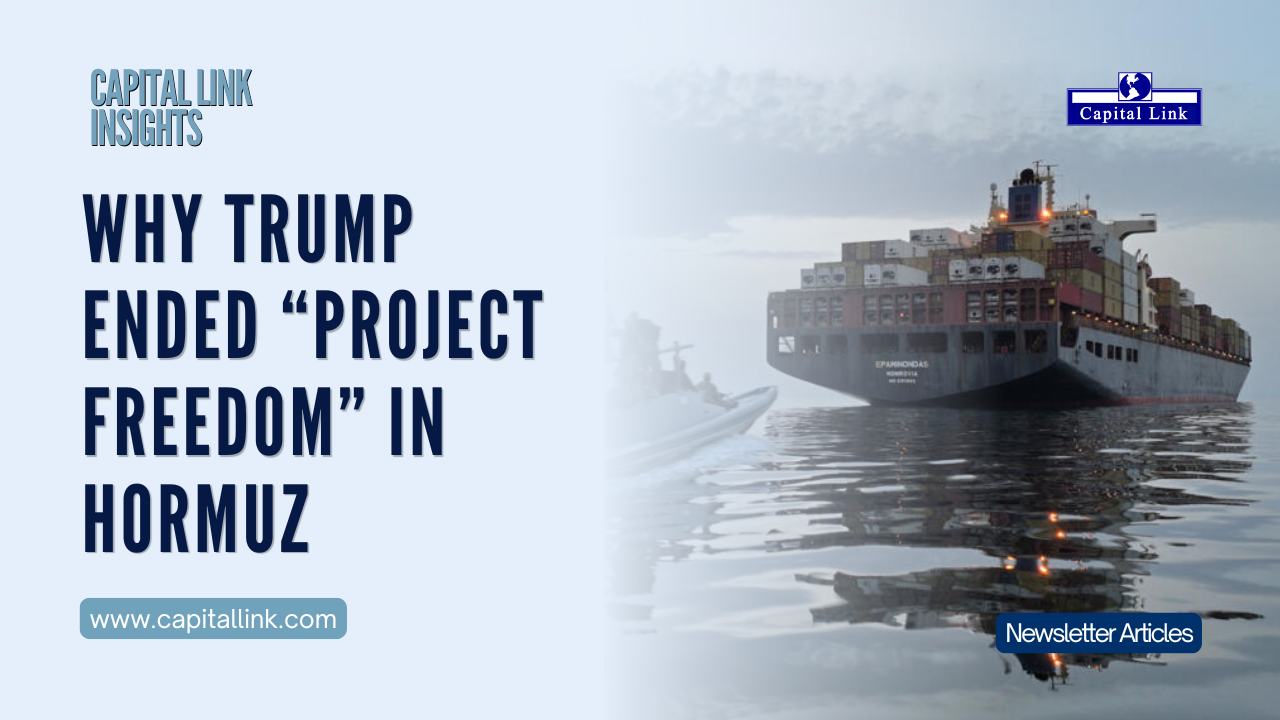
Yesterday, US President Donald Trump announced that the US operation “Project Freedom” is to be temporarily paused, ceasing their efforts to guide stranded vessels through the Strait of Hormuz.
Recently, President Trump has been alternating between diplomacy and military action. For the moment, diplomacy appears to be gaining ground as the president suspended the operation, citing progress in peace negotiations with Tehran.
Iranian media view this decision as a victory, saying it demonstrated that Trump retreated after continued failures to reopen the waterway.
Currently, the diplomatic efforts are focused on finding a formula acceptable and rewarding to both sides, one that could lead to de-escalating the war.
The American president noted on his social media platform, Truth Social, that this decision was highly influenced by Pakistan’s interference, which has been acting as an intermediary between the US and Iran due to its alliance the US and close proximity to Iran.
He further announced that the US blockade of Iranian ports would remain in place.
Based on the request of Pakistan and other Countries, the tremendous Military Success that we have had during the Campaign against the Country of Iran and, additionally, the fact that Great Progress has been made toward a Complete and Final Agreement with Representatives of Iran, we have mutually agreed that, while the Blockade will remain in full force and effect, Project Freedom (The Movement of Ships through the Strait of Hormuz) will be paused for a short period of time to see whether or not the Agreement can be finalized and signed.
Behind Trump’s shift in approach may lie the realisation that forcing Iran into capitulation is not an easy task. It has actually been argued that such expectations reflect a misunderstanding of the Islamic Republic’s strategy, and ability to adapt.
What happens now
Project Freedom was originally meant to help restore the flow of oil from the region and the global economy’s return to normal levels by guiding stranded ships out of the Gulf through the waterway.
The administration had stressed that Project Freedom was a separate and distinct campaign from the blockade, which is meant to pressure Iran economically. On the other hand, Iran appears to believe in their ability to outlast the US when it comes to said pressure.
It is worth noting that the Iranian government has strongly opposed the decision to halt this operation. In fact, the president of the Iranian parliament, Mohammad Bagher Ghalibaf, accused the United States and its allies of jeopardising maritime security.
For his part, Iranian President Masoud Pezeshkian stated that his country is ready to pursue open dialogue on every level. Nevertheless, he added that Iran did not capitulate in the past and does not plan to do so now.
Source: Capital Link Editorial
Author: Nancy Dordokidou