






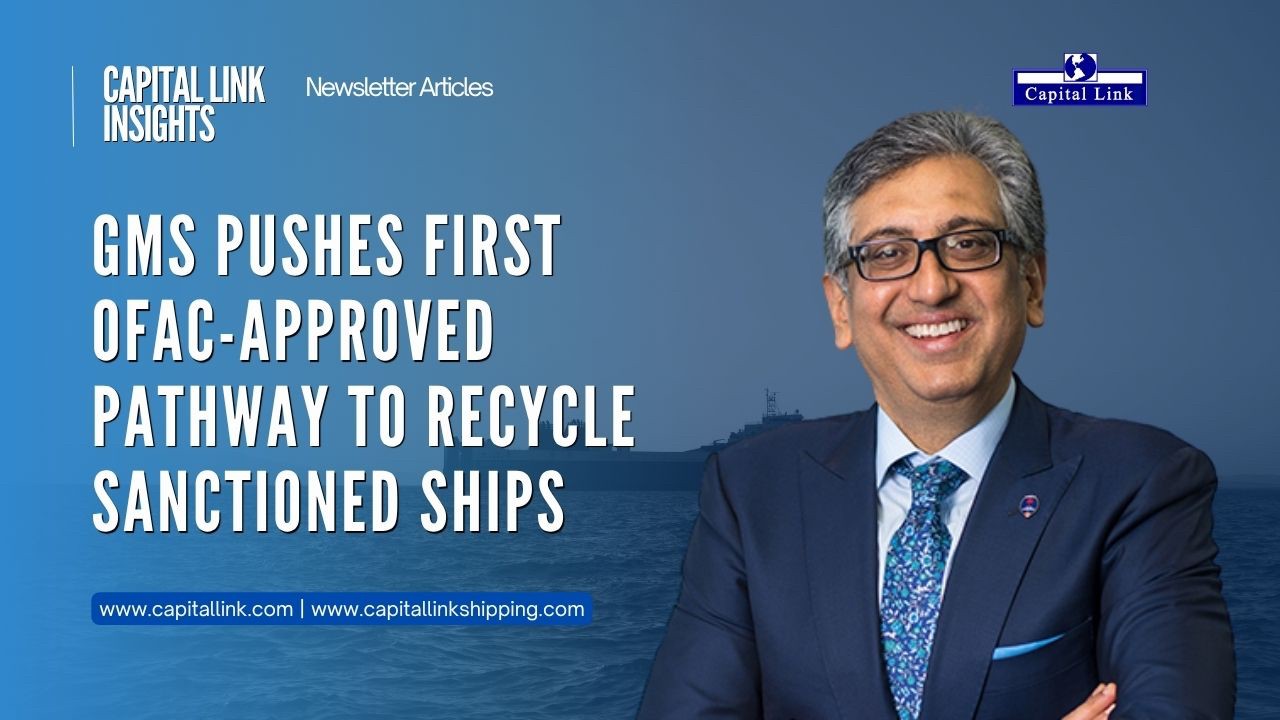
Recycling License Opens New Front in Battle Over Shadow Fleet
In this episode of Capital Link’s Expert Talks Series, Dr. Anil Sharma, Founder and CEO of Global Marketing Systems ( GMS Leadership ), discussed the groundbreaking OFAC-licensed recycling transaction for sanctioned vessels and its wider implications for the maritime industry.
Dr. Sharma explained that GMS has helped establish the first credible, legally controlled pathway for sanctioned vessels to exit the system through recycling. The significance of the approval is not limited to the recycling of four ships. It creates an important precedent for how high-risk sanctioned vessels can be permanently removed from commerce under strict legal, financial and operational controls.
A Problem with No Exit Route
GMS has secured what may become a landmark precedent for the industry, creating a potential pathway for retiring ships operating within the sanctioned and shadow fleet.
The license follows months of engagement with U.S. authorities after GMS submitted its application for four sanctioned container vessels. Dr. Sharma noted that the issue became a priority after discussions at the Capital Link Maritime Forum in Dubai on November 11, 2025, during Bahri Week, where the question of a lawful route to retire dark fleet vessels was raised.
History was formally made on April 10, 2026, when the U.S. government issued licenses for the four sanctioned vessels. For Dr. Sharma, however, the importance of the approval goes beyond the specific ships involved. It raises a wider question for the industry: can this become a responsible, government-supported mechanism for removing high-risk sanctioned vessels before a major maritime or environmental incident forces the issue onto the global agenda?
Dr. Sharma described the sanctioned and shadow fleet as a growing risk for the entire maritime community. If an old sanctioned vessel cannot trade legally, cannot be financed legally, cannot be insured properly, cannot be classed properly, and cannot be recycled legally, then the industry has created a floating problem with no exit.
According to Dr. Sharma, a lawful, controlled and compliance-led recycling mechanism is not a loophole. It is a preventive mechanism. It removes risk from the sea, prevents dangerous assets from continuing to operate in opaque trades, and creates visibility where there may otherwise be none.
The significance of the OFAC approval is therefore not only the recycling of four vessels. It establishes a model that regulators and the industry can study and build upon. Each future application would still require case-by-case review because ownership structures, sanctions regimes, jurisdictions and vessel circumstances differ substantially.
“The challenge is that the first application took seven months, which is too slow a process,” Dr. Sharma pointed out.
A Controlled Exit, Not a Sanctions Loophole
Dr. Sharma stressed that the license is not a general permission to trade in sanctioned ships. It is not a relaxation of sanctions and it is not a commercial shortcut. It is a specific, controlled transaction involving named vessels, subject to conditions and regulatory oversight.
The distinction is important. A sanctioned vessel that remains afloat can continue to trade, change ownership, change flag, move through shell structures, or be used again in sanctioned commerce. A vessel that is responsibly recycled cannot trade again. It cannot carry cargo, earn freight, move sanctioned oil, or return to the market under a different identity.
This is why Dr. Sharma views licensed recycling as a terminal action rather than a continuation of commerce. The objective is not to reward sanctioned actors. The objective is to remove high-risk tonnage from circulation under strict legal supervision, with safeguards designed to prevent funds from flowing back into sanctioned trade.
In this sense, controlled recycling can support sanctions policy rather than weaken it. Sanctions are intended to isolate bad actors and restrict illicit benefit. They should not unintentionally create floating environmental hazards that remain at sea because there is no lawful route to retire them.
The Complex Process
Moving a sanctioned vessel from operation to recycling begins with identifying the ship and the owner willing to participate. According to Dr. Sharma, financial incentives alone are unlikely to drive participation. Owners may instead view cooperation as part of an effort to engage with authorities and improve their standing with regulators.
The process starts with vessel identification and ownership analysis, followed by legal reviews covering U.S., European Union, United Kingdom and other relevant sanctions exposure. The next stage involves a license application, followed by operational implementation.
Even after approval, Dr. Sharma observed that industry participants often remain cautious. Crewing managers, insurers, bunker suppliers, agents, classification societies, flag administrations, ports and banks all require verification before participating.
The final stage involves reporting and evidence submission to regulators, showing that the transaction proceeds exactly as approved and that the vessel is permanently removed from commerce.
Dr. Sharma emphasized that this is not merely a legal exercise. It is also a maritime execution challenge involving safe delivery, insurance, port permissions, flag and class issues, crew matters, hazardous-material documentation, recycling-yard selection and final dismantling evidence.
Following the Money
A central concern for regulators is ensuring that sanctioned actors do not benefit improperly from recycling proceeds. Dr. Sharma commented that GMS devoted substantial effort to documenting money flows and ownership structures.
The initial transaction was structured around vessels that were sanctioned while their owners were not, simplifying approval. Future cases may prove more complicated due to layered ownership structures, which are common in the sector.
“Who is the ultimate beneficial owner? And that itself is going to be a challenge,” Dr. Sharma questioned.
According to Dr. Sharma, any lawful sanctioned-vessel recycling mechanism must be built around transparency, visibility and audit trails. The process must answer who owns or controls the vessel, where the money goes, who is prevented from receiving proceeds, and how regulators can verify that the ship has been recycled responsibly.
The proceeds cannot simply flow back to sanctioned actors. The process must involve legal oversight, counterparty screening, approved financial channels, documentation, reporting and post-transaction evidence. The point is to bring the transaction into a controlled and auditable framework rather than allow vessels to disappear into opaque disposal channels outside regulatory visibility.
Economics of the Shadow Fleet
Dr. Sharma supported the notion that removing old sanctioned vessels could have meaningful economic implications even if sanctioned trade itself continues.
One comment he said resonated with U.S. officials was: “Sanctions did not eliminate the trade. They eliminated the rules. The trade is still growing, but the rules disappeared.”
He further explained that removing these ships can gradually reduce the fleet available to conduct sanctioned commerce. These vessels are valuable not only as steel, but because they may continue moving high-value cargoes outside mainstream oversight. Even an old and risky vessel may remain economically useful to sanctioned networks if it is allowed to keep trading.
Licensed recycling changes that equation. Without a lawful exit route, a vessel may continue generating revenue in opaque trades. With a licensed and monitored recycling route, the same vessel can be permanently neutralized as a revenue-generating asset.
Dr. Sharma was careful to distinguish between a secondary market and a controlled disposal channel. The industry does not need a speculative market in sanctioned vessels. What is needed is a lawful, case-by-case disposal mechanism that removes risk from the system.
Environmental and Safety Risks
Beyond economics, Dr. Sharma repeatedly returned to environmental and safety concerns. Many shadow fleet vessels operate with limited oversight, uncertain insurance arrangements and questionable maintenance standards. Dr. Sharma pointed to historic tanker disasters such as the 1979 collision of two VLCCs and the Exxon Valdez spill as examples of the scale of risk involved.
A major spill involving a sanctioned tanker could carry cleanup and economic costs measured in tens of billions of dollars, according to Dr. Sharma, who then questioned who would ultimately carry responsibility for such an accident.
“It is not the sanctioned country that is going to pay. It is going to be wherever the pollution happened,” Dr. Sharma noted.
He also referred to the United Nations operation involving the decaying FSO Safer off Yemen as evidence that governments and international organizations eventually bear the cost of preventing environmental disasters when ageing vessels are left unmanaged for too long.
His argument is that transparent, audited recycling offers a better alternative than allowing vessels to remain at sea until they become a larger safety, environmental or financial problem.
Toward a Multi-Jurisdiction Framework
While the first breakthrough came through OFAC, Dr. Sharma expects future efforts to require coordination across multiple authorities. Future cases may require consideration of U.S., European Union, United Kingdom and other sanctions regimes, along with flag, port, banking, insurance, class and recycling-state requirements.
Still, Dr. Sharma believes the foundation has now been established. The goal is not to create a loophole or encourage trading in sanctioned ships. The goal is to create a lawful mechanism that allows governments to remove high-risk vessels from the water while maintaining control over ownership, payment flows, recycling standards and final evidence.
For GMS, which has recycled more than 5,000 ships over three decades, the objective remains focused on vessel retirement and responsible recycling, not on sanctioned trading opportunities. Dr. Sharma noted that this type of process should not be handled through informal channels or opaque intermediaries. A lawful pathway requires credible participants, strong documentation, regulated financial channels, responsible recycling standards and clear evidence of completion.
“Our focus is entirely on the recycling component. Let’s create visibility and transparency. Let’s create a regime that is able to audit how this works,” he concluded.
SOURCE Capital Link