






The 10th Capital Link Maritime Leaders Summit – Greece was successfully held on Monday, June 1, 2026, as part of the Posidonia Week Conference Program. Organized by Capital Link in partnership with DNV and with the cooperation of NASDAQ and NYSE, the biennial event once again confirmed its position as one of the most prominent maritime gatherings during Posidonia Week.
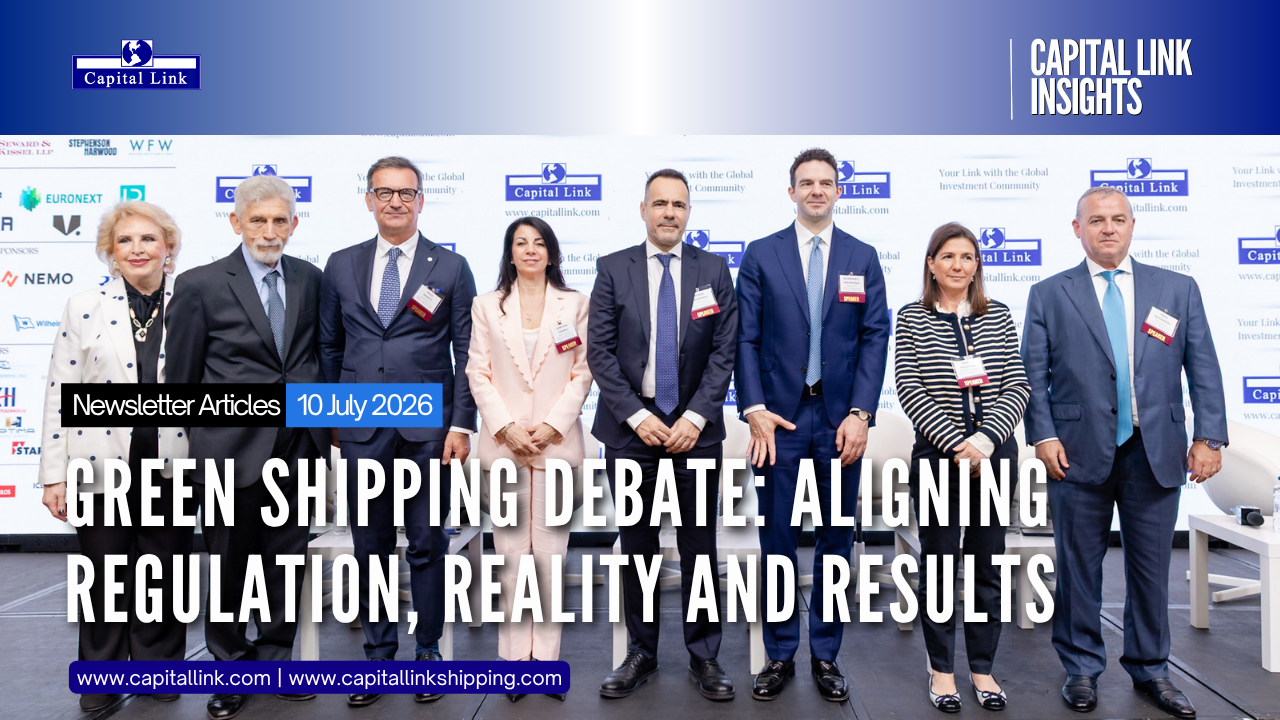
A panel that drew particular attention was “Green Shipping Debate: Aligning Regulation, Reality and Results,” which brought together leading figures from the shipping industry, including Μs. Dorothea Ioannou, Chief Executive Officer – American P&I Club, Mr. Andreas Hadjipetrou, CEO – Columbia Group, Mr. Polys Hajioannou, President – Cyprus Union of Shipowners (CUS); CEO – Safe Bulkers, Inc. (NYSE: SB), Mr. Alex Hadjipateras, COO – Dorian LPG Ltd. (NYSE: LPG); Managing Director – Dorian LPG Management Corp., Ms. Ioanna Procopiou, Managing Director – Prominence Maritime; President Designate – BIMCO. The discussion was moderated by Mr. Paolo Moretti, CEO – RINA SERVICES S.p.A.
The debate revealed agreement that the industry’s next phase will depend less on announcing increasingly ambitious climate goals and more on creating pathways to achieve them. Artificial intelligence, vessel efficiency upgrades, fuels already in commercial use are only some examples, while speakers repeatedly emphasized that fragmented regulation is bound to complicate investment decisions.
Mr. Moretti brought forth a familiar sentiment, supporting the notion that the industry should focus on technologies capable of delivering reductions today instead of relying on fuels that remain years away from large-scale deployment. LPG, he said, has already demonstrated its value and new-generation engines continue to lower fuel consumption.
Artificial intelligence is also beginning to deliver operational benefits, with voyage optimization and improved communication between ship and shore helping reduce consumption. Carbon capture, Mr. Moretti added, is still one of the industry’s most promising longer-term technologies, although storage infrastructure and logistics still present obstacles.
Mr. Hadjipateras agreed, pointing out that those technologies are already moving beyond theory. Dorian LPG is integrating AI into weather routing and operations but also investing in training programs to ensure seafarers can work alongside these digital tools. “The goal is to reduce consumption and achieve better communication with the office,” he noted.
Carbon capture has the potential to become a contributor to the decarbonization efforts, he further commented, although its commercial deployment is still limited due to the unclear regulatory environment.
For Mr. Hadjipateras, the industry’s focus should remain on solutions already capable of delivering measurable emissions reductions. “Ambition without feasibility is just wishful thinking,” he shared, saying that LPG and other commercially proven fuels should serve as practical stepping stones while shipping continues evaluating future energy options.
Consequently, that emphasis on practicality was echoed by Mr. Hajioannou, who stated that environmental policy has to be be grounded in economic reality if it is to succeed.
“We support ambitious environmental objectives, but ambition must be matched by technical and economic feasibility. The shipping industry supports global standards developed through the IMO because they create a level playing field for operators worldwide,” he divulged. “Regional approaches, by contrast, risk introducing competitive distortions.”
If carbon taxes or similar market-based measures are adopted, Mr. Hajioannou sees a meaningful share of the revenues reinvested into developing alternative fuels and supporting their commercial deployment. Without financial incentives, adoption will remain limited because the economics have yet to justify large-scale investment.
The Legal Background of Energy Transition
Historically, international maritime regulation focused on hydrocarbons and oil pollution, Ms. Ioannou shared with the audience, when discussing the legal aspect of things. Today’s range of alternative fuels and propulsion technologies introduces legal questions that existing conventions were never designed to address.
“International conventions create certainty. They establish liability rules, compensation mechanisms and insurance frameworks.”
But, she continued, without globally accepted conventions, shipowners could find themselves navigating conflicting national regulations and inconsistent legal treatment, increasing commercial risk.
She also drew some attention to nuclear propulsion as one example of how regulation continues to lag technological discussion.
She noted that there is no international legal framework governing commercial nuclear-powered vessels right now, leaving marine insurers unwilling to assume the associated risks. Until legal certainty exists, nuclear propulsion is unlikely to become a commercially viable option, Ms. Ioannou concluded.
Is Investment a Viable Option?
Investment presents another challenge, according to Mr. Hadjipetrou who said that “large investments are required” for such a cause. Nevertheless, “not all companies have the financial capacity to make those investments at the same pace.”
He commented that any framework must therefore take into consideration the diversity of the shipping industry not just assume that every operator can move simultaneously.
“The industry supports decarbonization, but regulation has to be grounded in technological readiness, economic reality, legal certainty and measurable lifecycle.”
What Can Shipowners Do?
Finally, Ms. Procopiou shared a different opinion, stating that the shipping industry itself should be the one more actively involved in shaping climate policy.
“Many decisions are being made by people who do not fully understand how shipping operates. Governments and policymakers require better information if they are to design effective regulations.”
Ms. Procopiou also challenged assumptions about the availability of future fuels. She noted that global production of green hydrogen represents only a tiny fraction of fossil-fuel production. If shipping alone attempted to rely entirely on hydrogen-derived fuels, the renewable electricity required would exceed today’s wind and solar generation.
All those limitations make lifecycle analysis interesting to look at, and after all, evaluating fuels solely on emissions at the point of consumption ignores emissions generated during production, transportation and distribution, potentially encouraging policies based on incomplete data. No single participant in the maritime supply chain can deliver the transition alone, Ms. Procopiou reiterated. Shipowners, charterers, ports, fuel producers and cargo interests all have to take part in this because commercial adoption depends not only on environmental performance but also on economic viability.
Source Capital Link Editorial