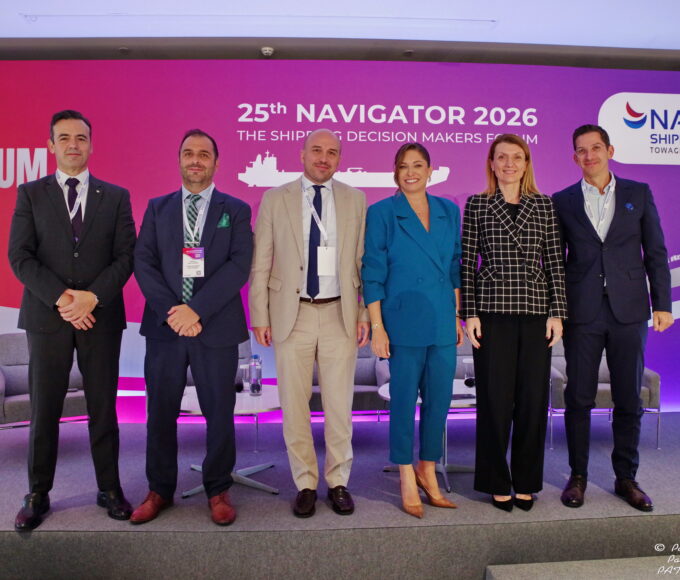





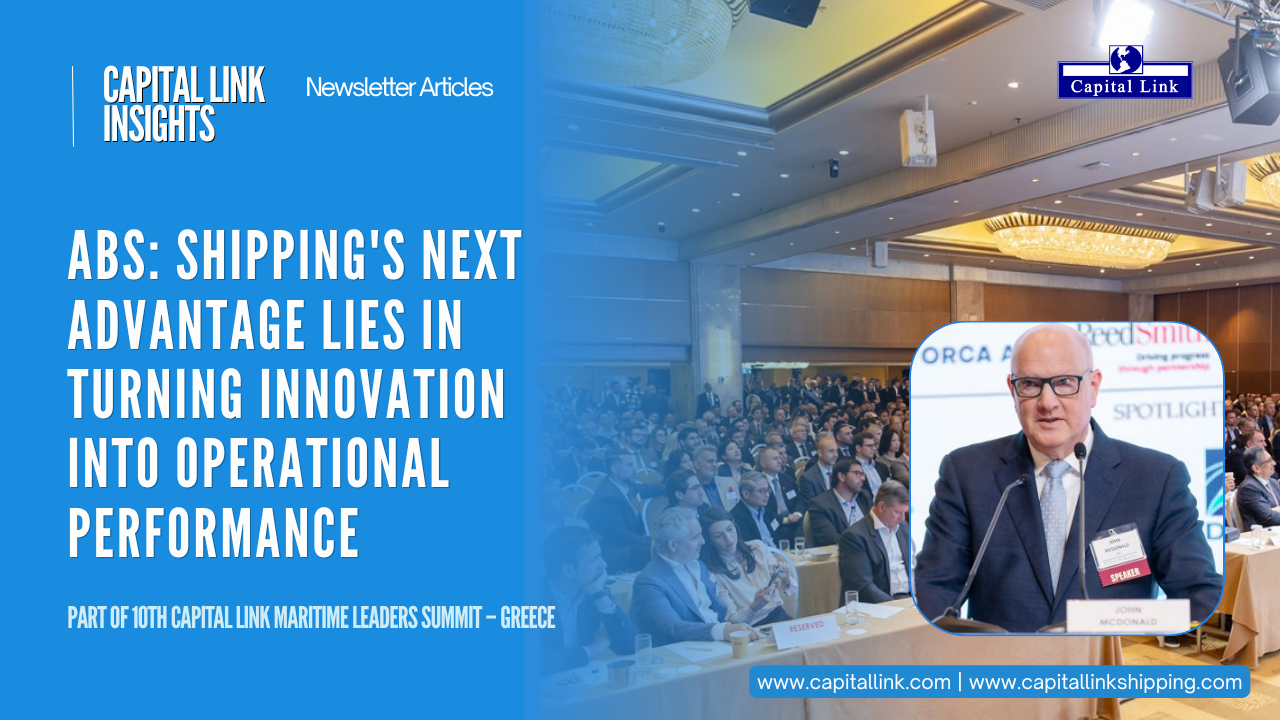
The 10th Capital Link Maritime Leaders Summit – Greece was successfully held on Monday, June 1, 2026, as part of the Posidonia Week Conference Program. Organized by Capital Link in partnership with DNV and with the cooperation of NASDAQ and NYSE, the biennial event once again confirmed its position as one of the most prominent maritime gatherings during Posidonia Week.
The maritime industry’s biggest challenge is no longer developing new technologies but ensuring they deliver measurable results aboard ships operating in an increasingly complex and costly environment, according to ABS Chairman and Chief Executive Officer Mr. John McDonald.
During his speech, Mr. McDonald noted shipowners face pressure from rising operating costs, capital markets, labor shortages and escalating cyber risks, creating an environment where the ability to successfully implement innovation has become a critical competitive differentiator.
“Access to innovation is no longer enough. Competitive advantage lies in the ability to integrate it safely, at scale, and without disrupting operations.”
His comments come as shipowners are trying to handle a wave of technological disruption ranging from artificial intelligence and robotics to digital twins and autonomous systems, while simultaneously navigating the industry’s decarbonization agenda and regulatory requirements.
Mr. McDonald argued that a significant gap remains between technologies that are technically feasible and those that can be reliably deployed across commercial fleets. Bridging that divide, he said, will determine how successfully the shipping industry adapts to a more digital and data-driven future.
The economic incentives are substantial. Fuel continues to represent between 50% and 70% of operating expenses for many vessels, according to Mr. McDonald, making efficiency gains all the more valuable.
He provided examples of operators achieving 10% improvements in vessel efficiency and reducing operating costs by as much as 8% through the deployment of advanced technologies.
Digital tools such as voyage optimization systems, performance monitoring platforms and data solutions are also helping operators cut fuel consumption by approximately 10%–15%.
Even incremental improvements can result in financial returns. A 1% reduction in fuel consumption on a large container vessel can translate into hundreds of thousands of dollars in annual savings, Mr. McDonald stated.
Artificial intelligence is moving beyond optimization functions into real time operational decision-making, while robotics is reshaping vessel inspection and maintenance practices. Digital twins and advanced simulation technologies are enabling operators to model performance before deployment and throughout an asset’s lifecycle. Other technologies including autonomous systems, embodied AI and nuclear propulsion could ultimately redefine vessel design, operations and energy systems, Mr. McDonald highlighted.
He did caution however that technological breakthroughs alone will not guarantee success.
“The challenge is no longer invention. It is execution,”
he added that new technologies must prove themselves on commercial vessels, integrate with existing systems and satisfy regulators, insurers and charterers before they can achieve widespread adoption.
To accelerate that transition, ABS recently launched the ABS SeaTech Innovation Exchange, a new initiative linking maritime technology development in the United States with operational deployment and training capabilities in Greece. The program is designed to connect startups, researchers, investors and shipowners and help technologies move more quickly from concept to commercial application.
Mr. McDonald also highlighted the need for workforce readiness, arguing that technology investments will only generate value if crews and shore-based personnel are trained to use them.
As digital systems become more sophisticated, learning, simulation-based training and immersive exercises are becoming essential components of maritime competitiveness, he said. The emergence of AI decision support systems is also expected to increase the need for transparency.
“A new era of shipping is taking shape now. It will be more connected, more data-driven, and more technically capable than anything we have seen before.”