





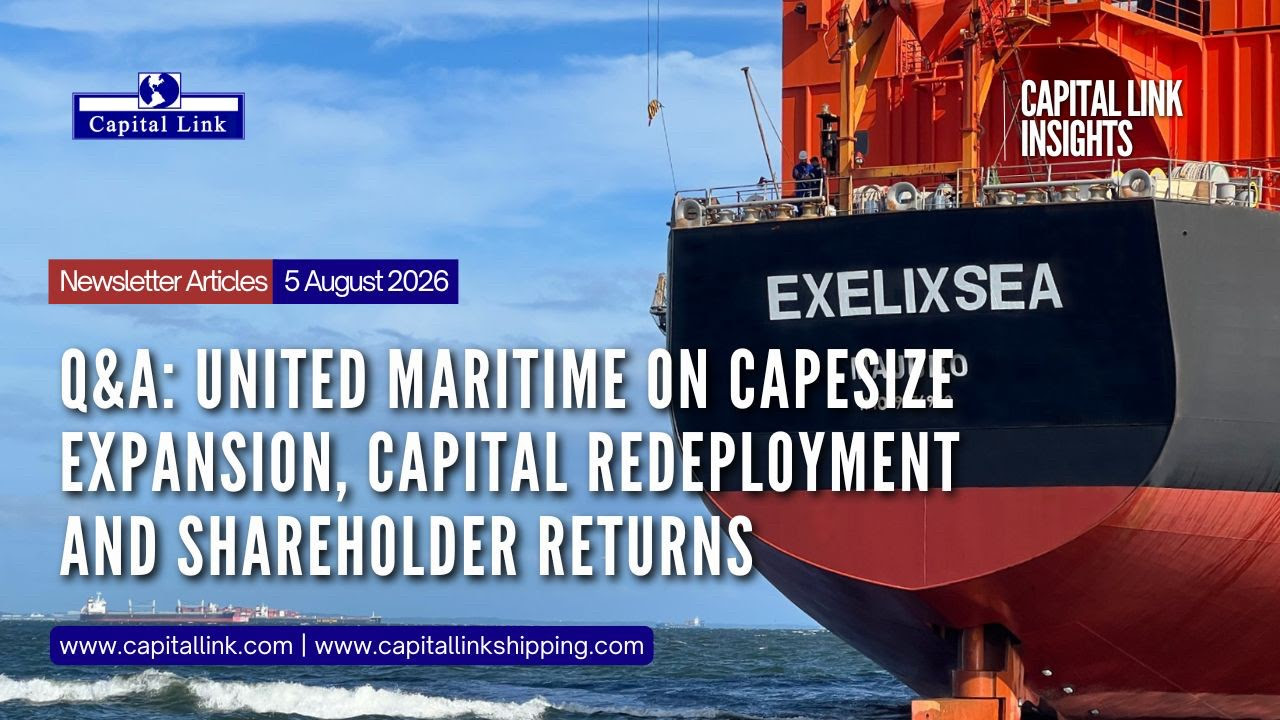
Following United Maritime Corporation’s (NASDAQ: USEA) second-quarter 2026 conference call, Capital Link interviewed Chairman and Chief Executive Officer Stamatis Tsantanis, to discuss the Company’s substantially repositioned fleet, increased exposure to the Capesize market and additional liquidity available for future investments and shareholder returns. Rather than emphasizing the quarterly earnings comparison, the discussion focused on the sale of older Panamax and Kamsarmax vessels, the addition of two Capesize vessels and the profitable exit from an offshore energy construction-vessel investment.
In the following Q&A, Mr. Tsantanis discusses how United Maritime is redeploying capital, strengthening its earnings profile and balancing further growth with consistent shareholder distributions.
Click on the following links to access United Maritime Corporation’s Q2 2026 materials:
Q: What was the most important strategic development during the first half of 2026?
A: United substantially completed the fleet-repositioning strategy announced earlier in the year. Since the beginning of 2026, it has sold two vessels in the Kamsarmax/Panamax classes while adding two Capesize vessels, increasing its exposure to a segment that management considers structurally stronger.
The 2010-built Capesize M/V Dukeship joined the fleet during the first quarter, followed by the delivery of the scrubber-fitted M/V Squireship in June. At the same time, United sold the 2009-built Kamsarmax M/V Cretansea and agreed to sell the 2011-built Panamax M/V Exelixsea.
Chairman and Chief Executive Officer Stamatis Tsantanis said this repositioning has increased United’s earnings capacity and free-cash-flow potential. The second half of 2026 should provide a clearer view of that impact because the Squireship will contribute for a full quarter beginning in the third quarter.
Q: How has United funded the shift toward Capesize vessels?
A: The Company has relied on asset sales and investment monetization rather than new public equity. Approximately $29.5 million of liquidity has been generated or is expected from three transactions during 2026.
The sale of the Cretansea for $14.7 million generated approximately $5.9 million of net cash after debt repayment. The agreed $17.5 million sale of the Exelixsea is expected to provide another $8.5 million of net proceeds and a gain of approximately $1.8 million when the vessel is delivered, currently expected toward the end of the third quarter. United also completed its exit from an offshore energy construction-vessel investment, generating approximately $15.1 million in cash and an accounting gain of about $0.5 million.
Management described the offshore exit as the completion of a capital-redeployment cycle that allows United to refocus on its core shipping operations. The proceeds increase its capacity to pursue additional investments while continuing to return capital to shareholders.
Q: Why is United increasing its exposure to Capesize vessels?
A: Management believes secondhand Capesize opportunities offer a more attractive combination of earnings power and market fundamentals than smaller dry-bulk classes. Capesize rates strengthened significantly during the first half of 2026, supported by iron ore, bauxite and coal demand and limited effective fleet growth.
The Dukeship and Squireship increase United’s participation in that market without committing the Company to a large multi-year newbuilding program. The Dukeship is operated under an 18-month bareboat charter-in arrangement that includes a purchase obligation. United acquired the Squireship by assuming its existing sale-and-leaseback financing and related obligations.
Following the Exelixsea sale, United’s operating fleet is expected to consist of five vessels: two Capesizes, one Kamsarmax and two Panamaxes. Management said it will continue evaluating quality secondhand Capesize acquisitions, provided they are accretive on a per-share basis.
Q: How is United balancing additional investment with shareholder returns?
A: United declared a quarterly cash dividend of $0.10 per share, its 15th consecutive quarterly distribution. Since beginning distributions in November 2022, the Company has declared approximately $2.04 per share, or about $16.8 million in aggregate cash dividends. Based on the July 27 closing share price cited in the earnings release, the latest quarterly dividend represented an annualized yield of approximately 16%.
During the conference call, management said consistent profitability is intended to support a consistent dividend and reiterated that shareholder returns remain a top priority. United has also executed share repurchases while avoiding a new public equity offering since its 2022 initial public offering.
The capital-allocation approach therefore has three components: recycle capital from older or non-core assets, invest selectively in higher-earning vessels and maintain recurring distributions. Management emphasized that potential acquisitions must create value on a per-share basis rather than simply increasing fleet size.
Q: How much earnings visibility does the Company have for the remainder of 2026?
A: United has converted the index-linked rates on three of its six vessels into fixed-rate employment through the end of 2026, balancing visibility with continued participation in stronger markets. The Squireship’s charter, for example, was converted to an average fixed gross rate of approximately $28,246 per day through year-end.
As of July 30, approximately 75% of expected third-quarter operating days had been fixed at an estimated TCE rate of approximately $21,388 per day. Including assumptions for the remaining index-linked days, United guided to a third-quarter fleet TCE of approximately $20,418 per day, compared with $18,654 in the second quarter.
The earnings figures provide context for the strategy. First-half fleet TCE increased 35% to $17,202 per day, while adjusted EBITDA rose to $8.4 million from $6.0 million. The important point for investors is that the higher-earning fleet and selective fixed-rate conversions are intended to support more consistent cash flow for dividends and reinvestment.
Q: What supports management’s constructive dry-bulk outlook?
A: Demand strengthened across several major commodities during the first half. China’s iron ore imports increased more than 6% year over year, with second-quarter volumes reaching a record. Vale reported its strongest second-quarter production since 2018, while the Simandou project in Guinea continued ramping up exports. Longer-distance Atlantic cargoes can also support tonne-mile demand for Capesize vessels.
Bauxite has become another important Capesize driver. Guinean exports increased more than 15% during the first half, supported by Chinese demand and activity in the alumina sector. Global seaborne coal volumes increased approximately 2.5%, while energy-security considerations and seasonal electricity demand could provide further support. Grain trade also strengthened the Panamax market.
On the supply side, newbuilding deliveries remain limited, particularly for Capesize vessels. Dry-dockings, slower sailing speeds and environmental regulations are constraining effective capacity, while the global fleet continues to age. Limited shipyard availability also reduces the risk of a rapid increase in vessel supply over the next several years.
Q: What are the principal opportunities and risks for investors?
A: The main opportunity is that United’s repositioning may produce a stronger earnings and cash-flow profile without shareholder dilution. A full-quarter contribution from the Squireship, higher Capesize exposure, fixed-rate coverage and additional liquidity from the Exelixsea sale could improve the Company’s capacity to invest and distribute capital.
Additional secondhand Capesize acquisitions could further expand earnings capacity if completed at attractive valuations and financing terms. Management is also considering additional charter-rate coverage for 2027 when forward-market opportunities appear compelling.
The risks remain significant. Dry-bulk rates and vessel values are cyclical, and United’s smaller fleet creates greater sensitivity to individual vessel performance, off-hire and chartering decisions. Additional acquisitions could increase leverage and execution risk. Demand remains exposed to China’s economy and commodity imports, while geopolitical developments, tariffs, environmental costs and a future increase in newbuilding orders could weaken returns.
Investor Takeaway
Potential catalysts
- The Squireship will contribute for a full quarter beginning in the third quarter of 2026.
- Approximately $8.5 million of net proceeds are expected from the Exelixsea sale.
- Greater Capesize exposure and selective fixed-rate coverage could strengthen cash-flow generation.
- Additional accretive Capesize acquisitions could expand the Company’s earnings capacity.
Key risks
- Dry-bulk freight rates and vessel values remain cyclical and volatile.
- A concentrated fleet increases the financial effect of individual vessel performance and off-hire.
- Future acquisitions may introduce financing, leverage and execution risks.
- China’s commodity demand remains central to the Capesize and broader dry-bulk markets.
Capital-allocation perspective
United enters the second half of 2026 with a more Capesize-oriented fleet, improved commercial coverage and greater financial flexibility. The central investment question is whether management can continue converting capital released from older and non-core assets into accretive shipping investments while preserving a disciplined balance sheet and consistent dividend. Its recent transactions demonstrate that fleet growth and shareholder returns are being pursued through capital recycling rather than public-equity dilution.
About United Maritime Corporation
United Maritime Corporation is an international shipping company specializing in worldwide seaborne transportation services. The Company operates a fleet of six dry bulk vessels, comprising two Capesize, one Kamsarmax and three Panamax vessels, with an aggregate cargo carrying capacity of 666,260 dwt. Upon completion of the aforementioned sale of the M/V Exelixsea, the Company’s operating fleet will consist of five vessels (two Capesize, one Kamsarmax and two Panamax vessels), with an aggregate cargo carrying capacity of 589,899 dwt.
The Company is incorporated under the laws of the Republic of the Marshall Islands and has executive offices in Glyfada, Greece. The Company’s common shares trade on the Nasdaq Capital Market under the symbol “USEA”.
Please visit the Company’s website at: www.unitedmaritime.gr.