






Location: Arabian Gulf / Gulf of Oman / Regional
Incident: Naval / Military activity
Level: Advisory
Awareness of developments regarding access to the Strait of Hormuz
At 12:45 UTC, Iran’s Foreign Minister, Abbas Aragchi, released the following post on social media channels:
‘In line with the ceasefire in Lebanon, the passage for all commercial vessels through Strait of Hormuz is declared completely open for the remaining period of ceasefire, on the coordinated route as already announced by Ports and Maritime Organisation of the Islamic Republic of Iran.’
No further details or coordinating instructions have been released by Iranian maritime authorities at time of writing. Key points:
- The Israel / Lebanon ceasefire is for 10 days and will expire at on 26 April.
- The US / Iran ceasefire is for 2 weeks and will expire on 22 April.
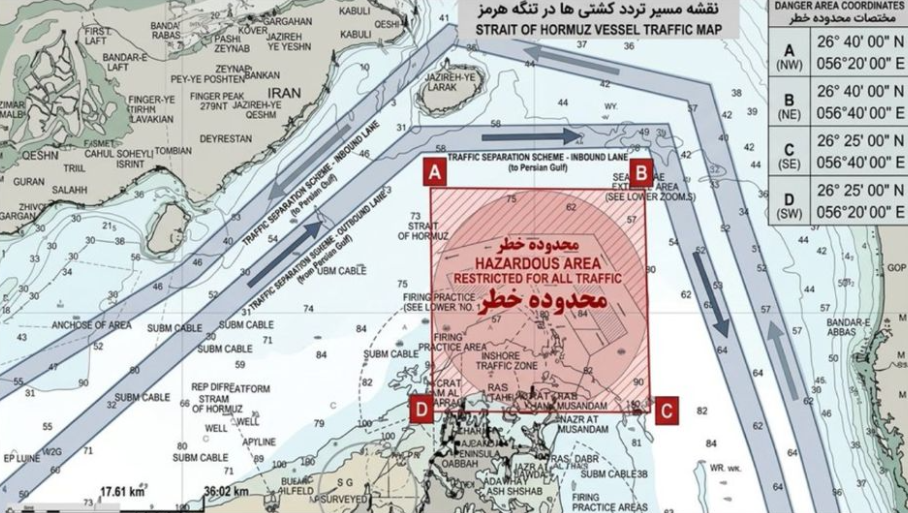
- The ‘coordinated route’ is a likely reference to the TSS via Larak / Qeshm Island as shown on the issued ‘mine danger area’ chart (below)
EOS Intelligence Assessment
We do not recommend that vessels begin transits of the Strait of Hormuz based on this single social media post. There are no details of coordination beyond those arranged thus far through bilateral government-to-government agreements since the imposition of the Larak / Qeshm ‘toll booth’. Those details remain largely opaque and there has been no return – or planning for return – to a system of traffic control that ensures prioritisation, deconfliction and safe passage.
Two US Navy minehunting vessels are steaming towards the region from the Far East; it is still a realistic possibility that Iranian mines have been laid and are unlocated. If Iran’s announcement of a mine danger area was a bluff – and there is very little evidence for or against at this stage – it is nevertheless prudent to assume at least a SUBSTANTIAL (an incident is a realistic possibility) mine threat in the Strait of Hormuz.
The Iranian Revolutionary Guard Corps (IRGC) is acting as the de facto maritime authority for the ‘coordinated route’. The IRGC’s command and control (C2) structure has been severely degraded over the past weeks and it is likely unable to control and coordinate anything approaching pre-conflict volumes of traffic through the Strait. In addition, IRGC military forces will almost certainly remain on high alert. The possibility of miscalculation and escalation is very real and could occur with little or no notice.
The first response from the US Administration has confirmed that the US blockade of Iran-associated shipping remains in place. This has the potential to increase the pressure on Iran’s economy quickly and severely. In turn, the likelihood of an aggressive Iranian response will increase in line with the pressure felt by the regime. Such a response could range from aggressive communications through boarding and seizure of a commercial vessel (reinforcing Iran’s ability to control access) to direct attack of a commercial vessel (reinforcing Iran’s ability to deny access).
What is not yet understood is US appetite to allow Iranian control of shipping via the ‘coordinated route’. There is a realistic possibility of further US / Iranian confrontation in the short term (<1 week) over the scope of Iran’s maritime control, potentially including ‘toll’ payments.
Guidance for Commercial Shipping
The baseline risk to vessels in the Arabian Gulf and Gulf of Oman remains SUBSTANTIAL (an incident is a realistic possibility), but in the context of a fluid and developing threat environment with the potential to escalate or de-escalate significantly in the next 24-48 hours. Notwithstanding Aragchi’s announcement, US blockade operations increase the risk of ceasefire failure and a return to local conflict, likely centred on the Strait of Hormuz but possibly throughout the Arabian Gulf and Gulf of Oman. The risk may increase to HIGH (an incident is likely) or EXTREME (an incident is highly likely) with little or no notice.
- We recommend that vessels do not attempt transit of the Strait of Hormuz until further details have been clarified and promulgated.
- We recommend that all vessels continue to maintain a 30nm standoff from US warships. This will avoid misidentification by the US warship and reduce the chances of mistaken targeting or ‘fly through’ by Iranian weapons should Iran attack the warship.
- We emphasise that transits based on bilateral, government-to-government agreements are not covered by this assessment, and vessels transiting on the basis of such agreements must do so based on their own or their government’s assessment of risk.
Vessels in the Arabian Gulf and Gulf of Oman should register with UKMTO and NAVCENT NCAGS for updates:
- NAVCENT NCAGS: +1-813-529-7108 (Primary/Watch Desk), +973-3986-4800 (Alternate), or m-ba-navcent-ncags@us.navy.mil or m-ba-navcent-ncags-ice@us.navy.mil
- UKMTO: watchkeepers@ukmto.org or +44 (0) 2392 222060. UKMTO advisories and warnings are available at https://www.ukmto.org/