





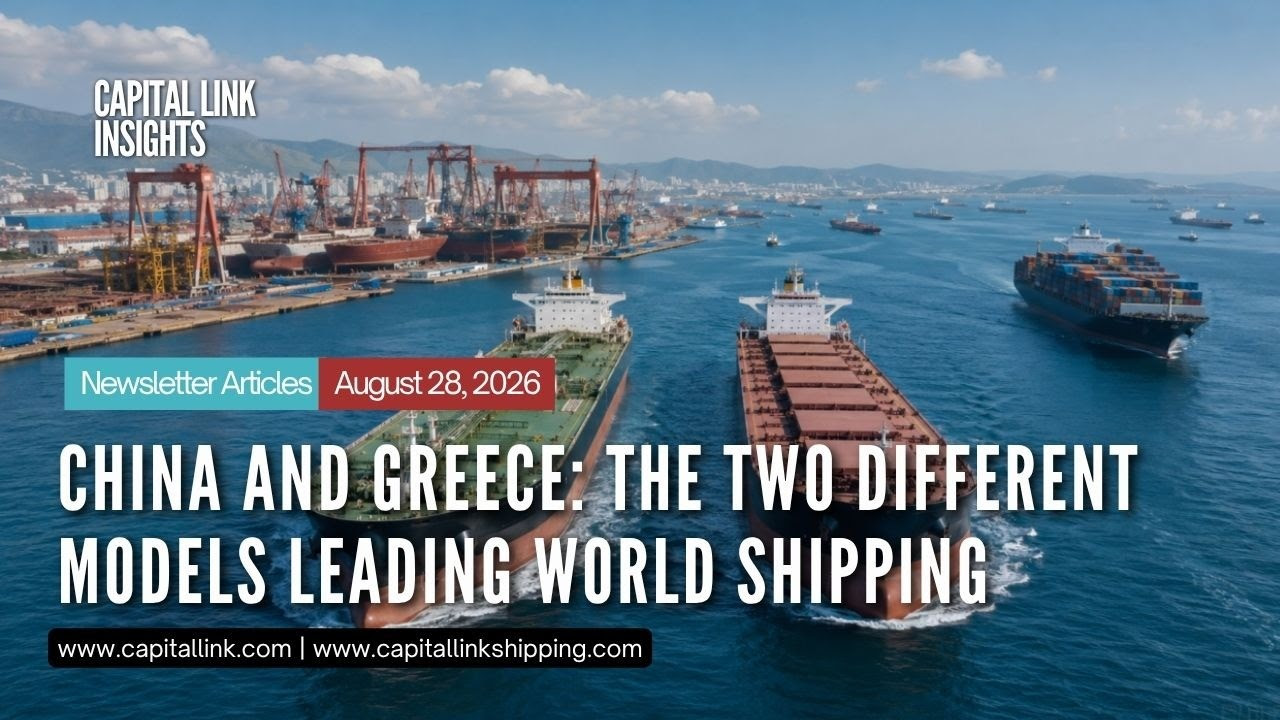
China draws on scale, state financing and its industrial base, while Greek shipping takes its strength from private enterprise, a global footprint and commercial flexibility
China and Greece stand today as the two strongest poles of world shipowning, and they represent two different approaches. On one side sits a system that ties together the state, the banks, the shipyards and the shipping companies. On the other, a decentralized business model built on private, often family-run firms with an international orientation.
Based on analysis by the shipbroking house BRS, China controls about 25% of the global fleet by number of ships, against 11% for Greece. That comparison, though, captures only one side of the real balance of power.
Greece still leads on carrying capacity. The Greek-owned fleet numbers close to 5,800 ships of more than 458 million dwt in total, representing 19.1% of world tonnage.
The Chinese model: state, cargoes and shipyards
The maritime rise of China rests on its enormous commercial and industrial base. In 2025 the country absorbed 40.5% of global seaborne bulk commodity imports, while the value of its goods exports came to $3.77 trillion.
Chinese shipping companies therefore have access to a large and relatively stable volume of cargo. Raw materials, energy products, containers and manufactured goods create a standing need for additional tonnage.
Fleet expansion is at the same time part of a wider national strategy. About 44% of Chinese tonnage sits under the control of state enterprises, which account for close to 64% of the country’s newbuilding orders.
SOURCE CAPITAL LINK
Please read more: https://www.linkedin.com/pulse/china-greece-two-different-models-leading-world-shipping-tavcf/