






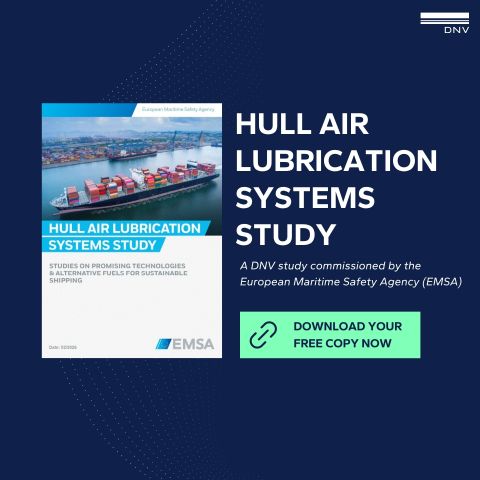
The European Maritime Safety Agency (EMSA) contracted DNV under Framework Contract 2024/EMSA/2024/OP/0025 to conduct various studies on promising technologies for sustainable shipping as air lubrication, onboard carbon capture and heat recovery systems; and updates of the previous alternative fuels studies as needed.
Under Specific Contract n° 2, a comprehensive assessment of Hull Air Lubrication Systems (ALS) focusing on their technological maturity, economic viability, regulatory context, and safety implications has been delivered.
Key highlights from the study include:
🔹DNV conducted interviews with leading ALS vendors, shipyards, model basins, and vessel operators to build a comprehensive picture of the current development status of ALS, as well as the key technical, operational, and commercial challenges facing large scale adoption.
🔹The study quantified the potential global GHG and fuel reduction impact of ALS using a performance estimation methodology developed in cooperation with technology vendors, covering multiple vessel types.
🔹The study highlighted the need for a commonly agreed methodology to assess the performance of ALS in view of the challenges posed by existing models to accurately account for all factors interacting with ALS.
🔹The study examined how ALS interacts with existing regulatory frameworks, including EEDI, EEXI, the IMO GHG Fuel Intensity (GFI) regulation, and EU GHG regulations, identifying areas where current rules do not yet fully accommodate ALS technologies.
🔹Drawing on cross sector experience and stakeholder input, DNV assessed the technical, operational, and safety related risks associated with ALS installation and operation.
Download the report here: https://lnkd.in/eAhxamaV